- Jun 28
Minimum Inventory Is Wrong. Sometimes.
- Arnaud Lemaire
- Accounting & Auditing
- 0 comments
Article 6 ended with a list. 150 items, $2.4 million, costing roughly $50,000 a month while nobody decides. It looks like an inventory-reduction project. That's the trap.
New here? This is part of a series on net working capital. Article 1 frames why working capital is three problems wearing one number. Article 6 cut DIO open, separated the stock you chose to hold from the stock that just accumulated, and put a price on standing still: 25% of inventory value per year, fully loaded. This week that price becomes a hurdle rate. The question is when holding more inventory actually makes you money, how to prove it, and what finally happens to those 150 items waiting for a verdict.
The reflex to call that list a reduction project comes from how most teams absorbed Lean: inventory is waste, so less is always better.
That rule is wrong. Sometimes.
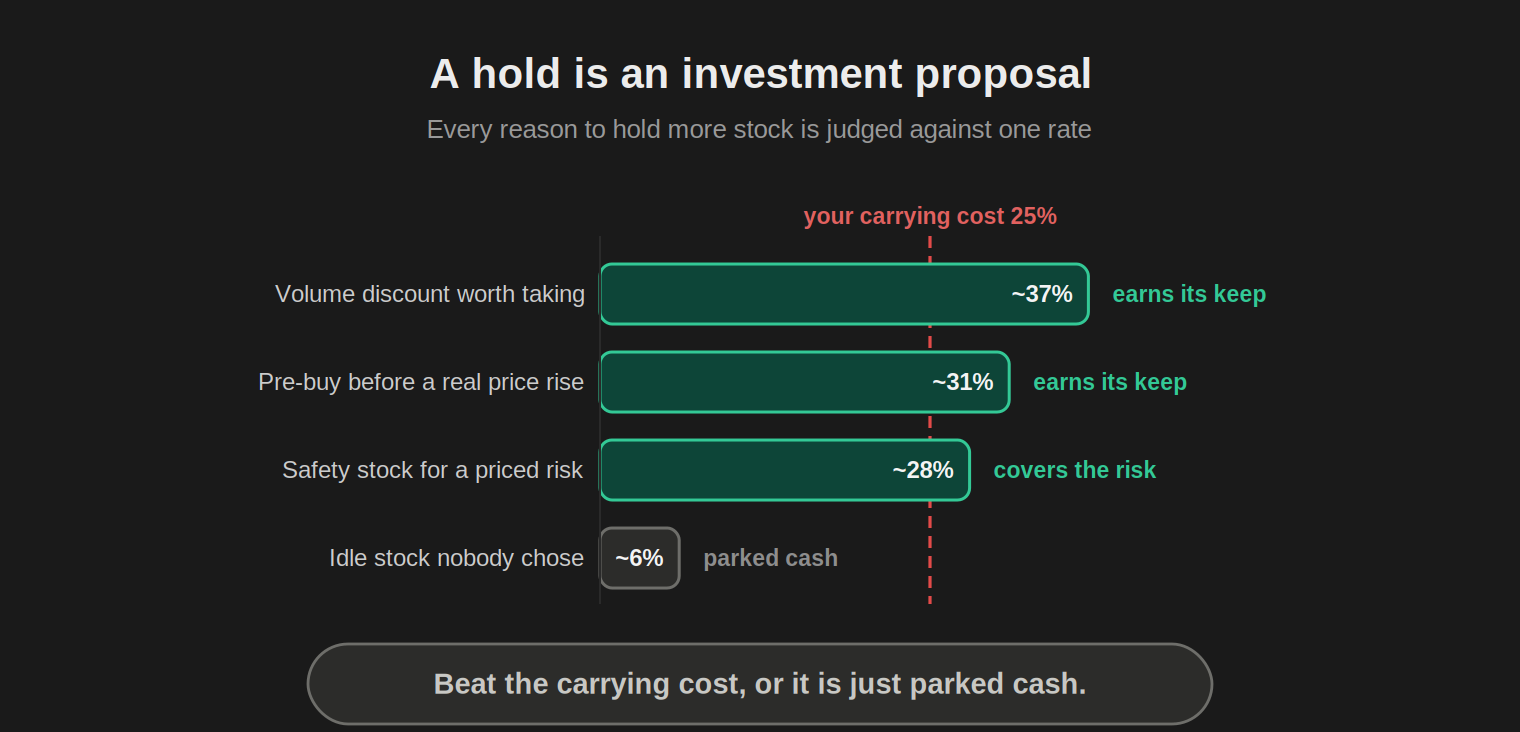
Sometimes the best available use of your company's cash is to turn it into pallets. A discount that beats your cost of capital. A supplier price increase you can buy ahead of. A supply risk you can insure for less than the damage it would cause. The difference between those holds and hoarding is a calculation, and you already have the number it needs, because Article 6 built it: 25% per year, the fully loaded carrying cost.
The hurdle was the point
The 25% wasn't only a way to make a slow-moving pile uncomfortable. It's a hurdle rate. Any proposal to hold more stock is an investment proposal, and investment proposals get judged against a rate. Yours is the carrying cost. A hold that earns more than it costs to carry is a candidate. A hold that doesn't is cash parked in the wrong place.
A candidate still has hurdles left. Cash position, warehouse space, and shelf life all get a vote. When the deal is material, replace the proxy with your incremental rate: the capital cost is real everywhere, but space, handling, and obsolescence risk differ wildly by SKU. Run the 25% first for the fast verdict. Price the increment before anyone signs.
Volume discounts are the cleanest place to watch the hurdle work, because the same discount can pass and fail depending on one variable that never appears on the quote.
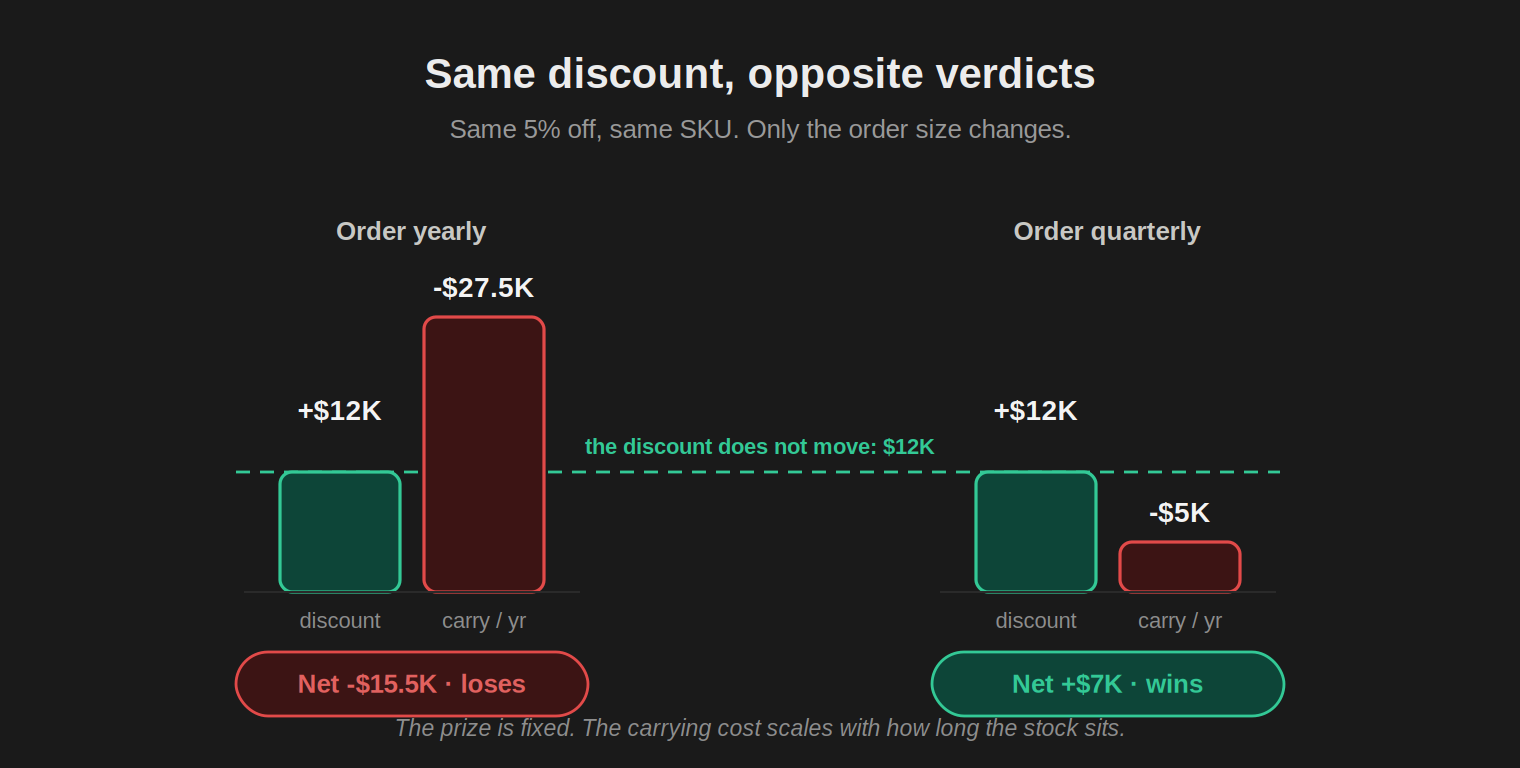
A supplier offers 5% off if you order yearly quantities instead of monthly. The SKU runs $240K a year. The discount is worth $12K. Procurement sees $12K of savings and a quote that expires Friday.
Now the other side. Ordering monthly, you hold about half a month of this SKU on average: $10K. Ordering yearly, you hold about half a year: $120K. The deal forces an extra $110K to sit on shelves. At 25%, that's $27.5K per year of carrying cost. You'd pay $27.5K to save $12K. The deal loses by $15.5K.
Same supplier, same SKU, same 5%, offered at quarterly quantities instead. Average stock rises from $10K to $30K. Extra carrying cost: $5K. The discount is still worth $12K. The deal wins by $7K.
The discount is a fixed prize. The carrying cost scales with how long the stock sits. That's why "we got 5%" tells you nothing by itself, and why two deals that look identical on the purchase order can be a gain and a leak. One assumption carries the whole calculation: that the bigger order actually lands in your warehouse earlier. If the supplier grants the discount for an annual commitment but still delivers monthly, you take the price break without holding the stock, and the carrying-cost penalty mostly disappears. The annual commitment by itself is harmless. The trouble starts when you take a year of delivery to earn it. (The averages assume steady consumption and cycle stock equal to half the order quantity. When the deal is material, add freight, order handling, minimum order quantities, and the obsolescence risk of holding a year of anything. The simple version still kills most bad deals on its own.)
Three more holds that can earn their keep
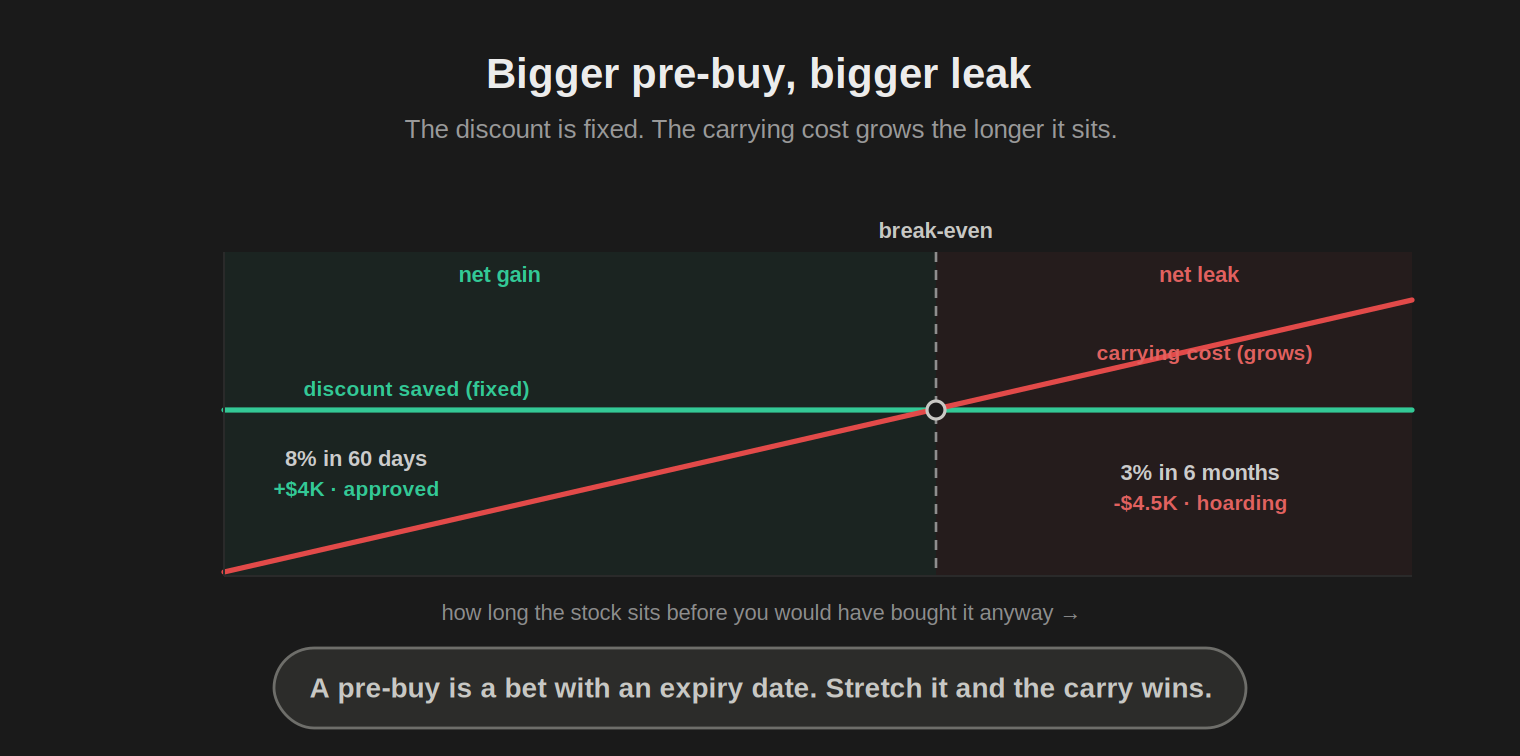
The pre-buy. A supplier announces an 8% price increase effective in 60 days. You pull forward an extra $100K of purchases at today's prices, on top of your normal ordering, and save $8K. The extra stock runs down over four months, so the incremental inventory averages about $50K for a third of a year: roughly $4K of carrying cost. The pre-buy nets about $4K. Approved.
Run the same play with a 3% increase and a six-month pull-forward and it flips: $4.5K saved, over $9K of carrying. Instinct says bigger pre-buy, bigger savings. The math says the carrying cost grows faster than the prize.
Tariff and geopolitical uncertainty have made this exact decision current again. The Hackett Group's 2025 European survey, covering 2024 performance, has DIO up 4% to 68.9 days, the highest in a decade, as companies built buffers against supply chain and geopolitical risk. Grant Thornton's 2026 cost outlook puts tariffs and supply chain frictions among the top risks, the kind that make sourcing and inventory choices outlast the disruption that prompted them. The math doesn't change because the headline did. A pre-buy is a priced bet with an expiry date, or it's hoarding with a news clipping attached.
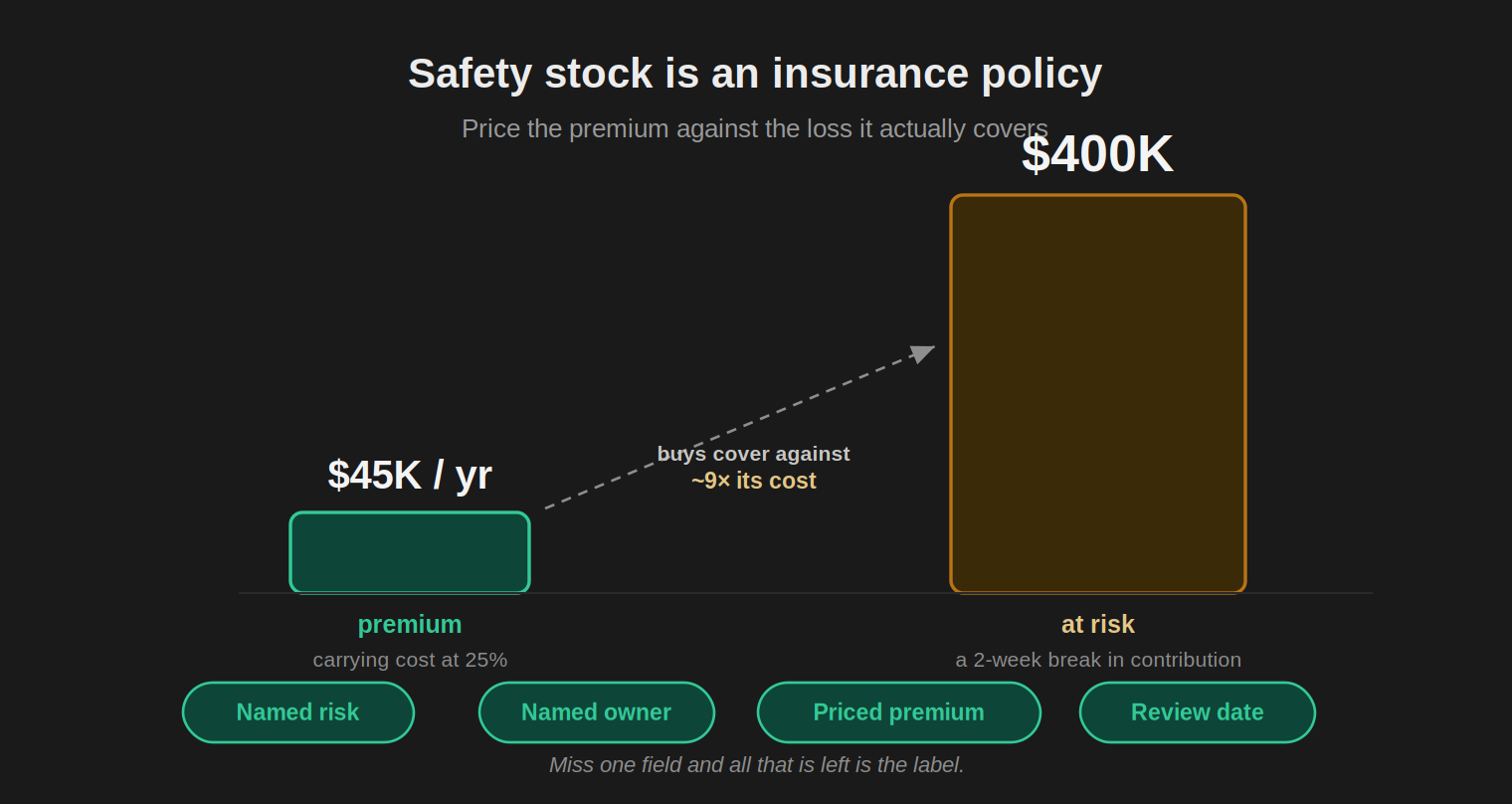
Safety stock with a name on it. A single-source component, twelve-week lead time, a supplier with a history of port delays. Holding six extra weeks of cover means $180K more inventory: a $45K-per-year premium at the 25% rate. Whether that premium is rational depends on the insured event. If a credible two-week supply break puts $400K of contribution at risk, paying $45K a year against that exposure can be rational, weighted by how often the supplier's history says it happens. If the risk is "you never know," you're looking at Article 6's red pile in a uniform.
The insurance frame carries its own discipline. A policy names the risk, prices the premium, and gets reviewed. Pin that review to an event rather than a date on the calendar: the day the supplier gets dual-sourced, the lead time normalizes, or the customer program ends is the day the premium needs re-justifying. When the risk disappears, the policy gets cancelled. Safety stock that outlives its risk is the most common species of accidental stock, and the hardest to spot, because the label still says safety.
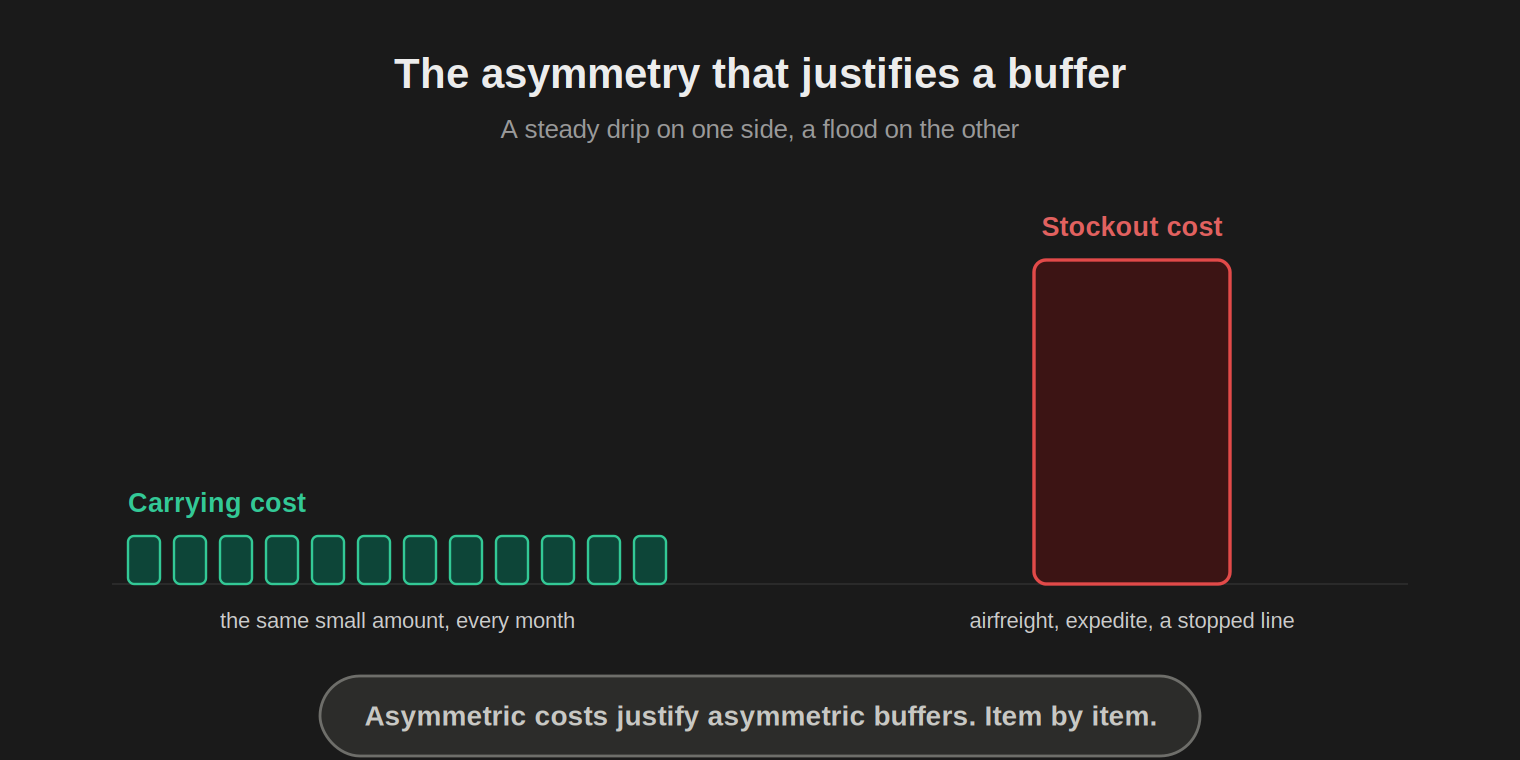
The stockout asymmetry. Carrying cost accrues quietly, the same amount every month. Stockout cost arrives all at once, with airfreight invoices, expedite fees, a stopped line, and a customer call you didn't want. For genuinely critical items the two costs are asymmetric, and asymmetric costs justify asymmetric buffers. The trap is letting that asymmetry argue for buffers everywhere. It argues for calculating item by item, because critical is a property of one part in one supply chain, never of the warehouse as a whole.
The 25% and the per-item carrying costs in these examples aren't round numbers I picked for the article. They come from a manufacturing inventory file I segmented and priced while building the Net Working Capital Operating Model on GoFast.Finance, the same file the course refreshes from a standard ERP export.
The other failure mode: too lean
The hurdle cuts both ways. Refuse a hold that clears it and you don't save money. You move the cost somewhere the inventory KPI can't see.
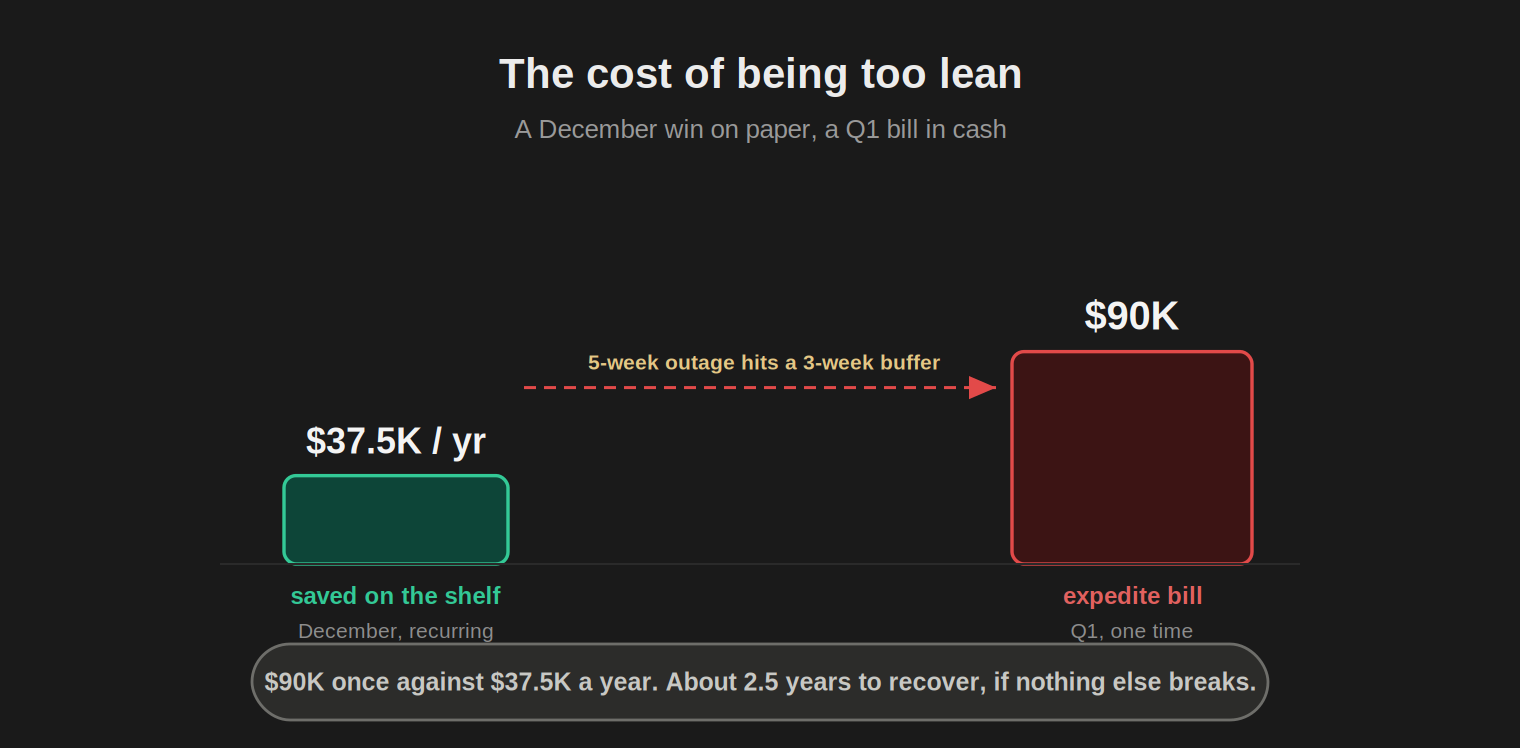
This shows up every year-end I've watched a working-capital push run without a price on the buffer. A controller gets told to release cash before the close. One target is a critical resin, single-source, on a ten-week replenishment cycle, used across three product lines. The team has always held eight weeks of cover against this supplier's disruption history. To free up cash, they cut it to three. Inventory drops by $150K, which at 25% reads as $37.5K a year of carrying cost saved, and the December balance sheet looks tighter. Clean win, on paper.
In Q1 the supplier has a five-week force majeure. Three weeks of cover against a ten-week lead time empties the buffer before any replacement lands, and two of the three lines face a stop. To keep them running, the company qualifies a spot supplier at a premium and airfreights emergency resin: $90K in one quarter, plus the requalification and a slowed line.
Tally it. A recurring $37.5K-a-year saving bought a $90K bill in a single quarter, and the buffer that got cut was the one insuring the supplier whose history said this would happen. The carrying cost was real, every month, quietly. The stockout cost was real too, all at once.
Here's the honest part, because this isn't an argument that leaner is always wrong. The saving recurs; the expedite hit lands once. If the disruption never came, the leaner buffer pays for itself in about two and a half years. The problem wasn't the direction of the cut. It was that nobody priced the eight-week buffer as a policy, named what it insured, or asked what a break would cost. The same missing calculation as the discount that looked like savings, run in reverse.
The 150 items, decided
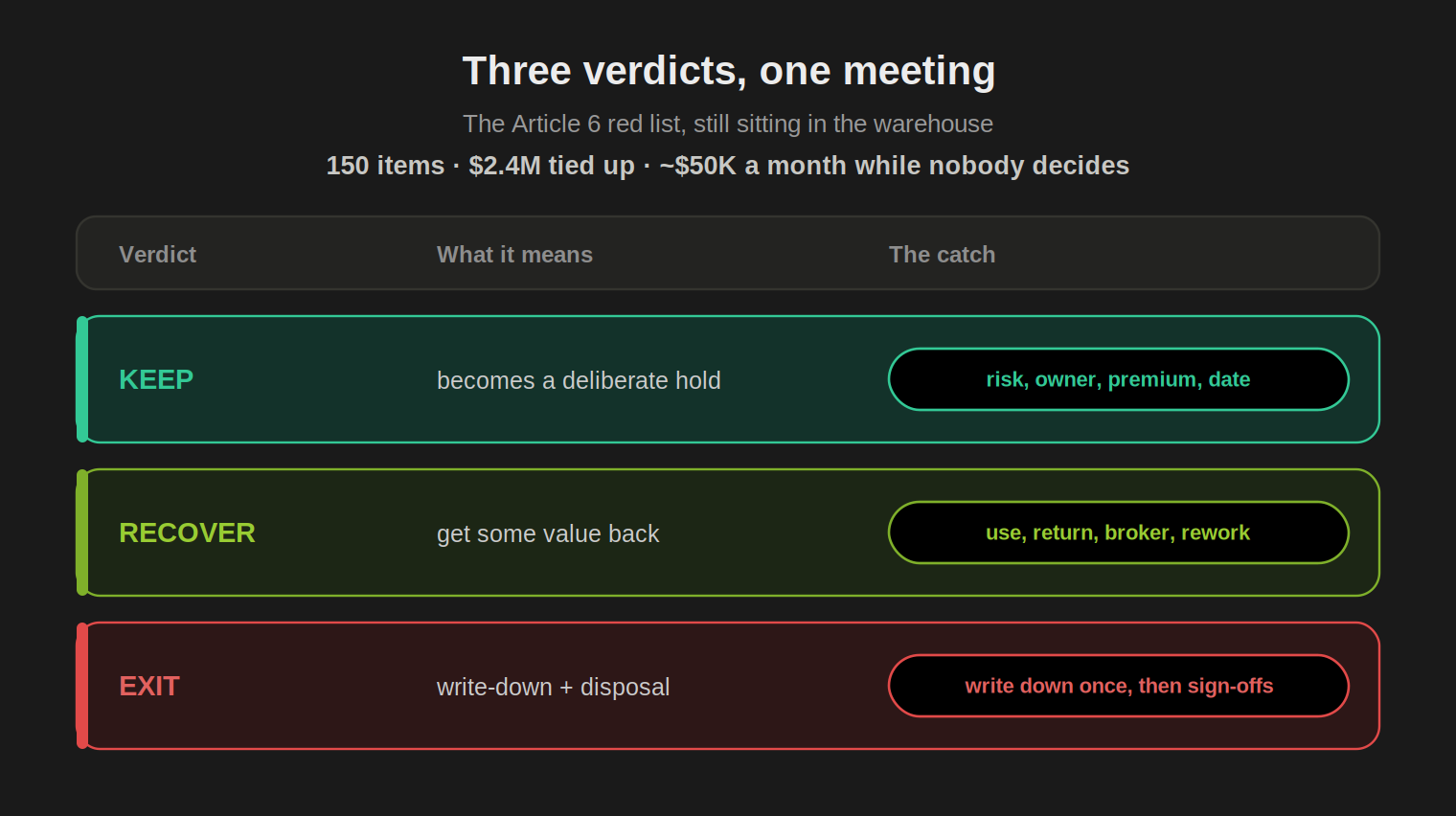
Article 6 deliberately stopped at the list: 150 red items, $2.4M, no owner, no documented reason. Here's the meeting that clears it.
Every item leaves with one of three verdicts.
Keep. Somebody looks at the carrying cost and signs. At that moment the item stops being accidental: it gets the four fields a deliberate hold needs, a reason, an owner, a priced premium, and a review date, and it moves to the deliberate pile honestly. Expect this to be the smallest group. Risks genuinely worth a 25% premium are rarer than warehouse square footage suggests.
Recover. Some of the value comes back: use the stock in production, return it to the supplier, sell it to a broker, rework it into a running item. Most of these moves belong to Procurement or Supply Chain rather than Finance, and selling below cost still triggers a write-down on the gap. Cents on the dollar feels bad until you compare it with paying 25% a year to keep the dollar frozen.
Exit. Two events hide in that word, and they get confused constantly. The write-down is an accounting obligation: when net realizable value drops below cost, the loss gets recognized, whether or not anyone has touched the pallet (IAS 2 under IFRS; US GAAP lands in the same place, writing impaired inventory down so the balance sheet stops carrying a cost it can't recover). The disposal is a physical process, and depending on your industry it may need Quality, EHS, customs, or customer sign-off before anything reaches the scrap container. Exit is the verdict everyone avoids, because it turns a quiet balance-sheet number into a visible P&L hit. But the quiet option has rent. An item worth $10K that nobody will ever use costs $2.5K a year to not decide about. The write-down happens once. The rent renews.
Decision rights matter more than the categories. Finance prices the three options for every item: carrying cost per year, realistic recovery value, write-down impact. Operations owns the keep call, because they own the risks the stock supposedly covers. Procurement and Supply Chain own most recover moves: returns, broker sales, supplier negotiations. The exit call is joint with accounting. A finance team that scraps inventory unilaterally is guessing about risks it can't see; an operations team with no price tags will keep everything.
Run this meeting a few times and the same three back-stories keep producing red items. An engineering change orphaned a component and nobody flagged the old part. An item meant to be made to order was set up as make to stock, so the system dutifully builds inventory for an order that arrives once a year. A safety stock parameter was set five years ago for a demand pattern that no longer exists. Notice what these share. Almost none of the red pile was a bad decision. It was a reasonable decision that expired, in a system where noticing expiry dates is nobody's job.
That's the deeper use of the carrying cost: beyond gating new holds, it's the renewal price of every existing one. A hold that wouldn't be approved again at today's premium has expired, whatever the label says.
Why this works: local vs. system optimization
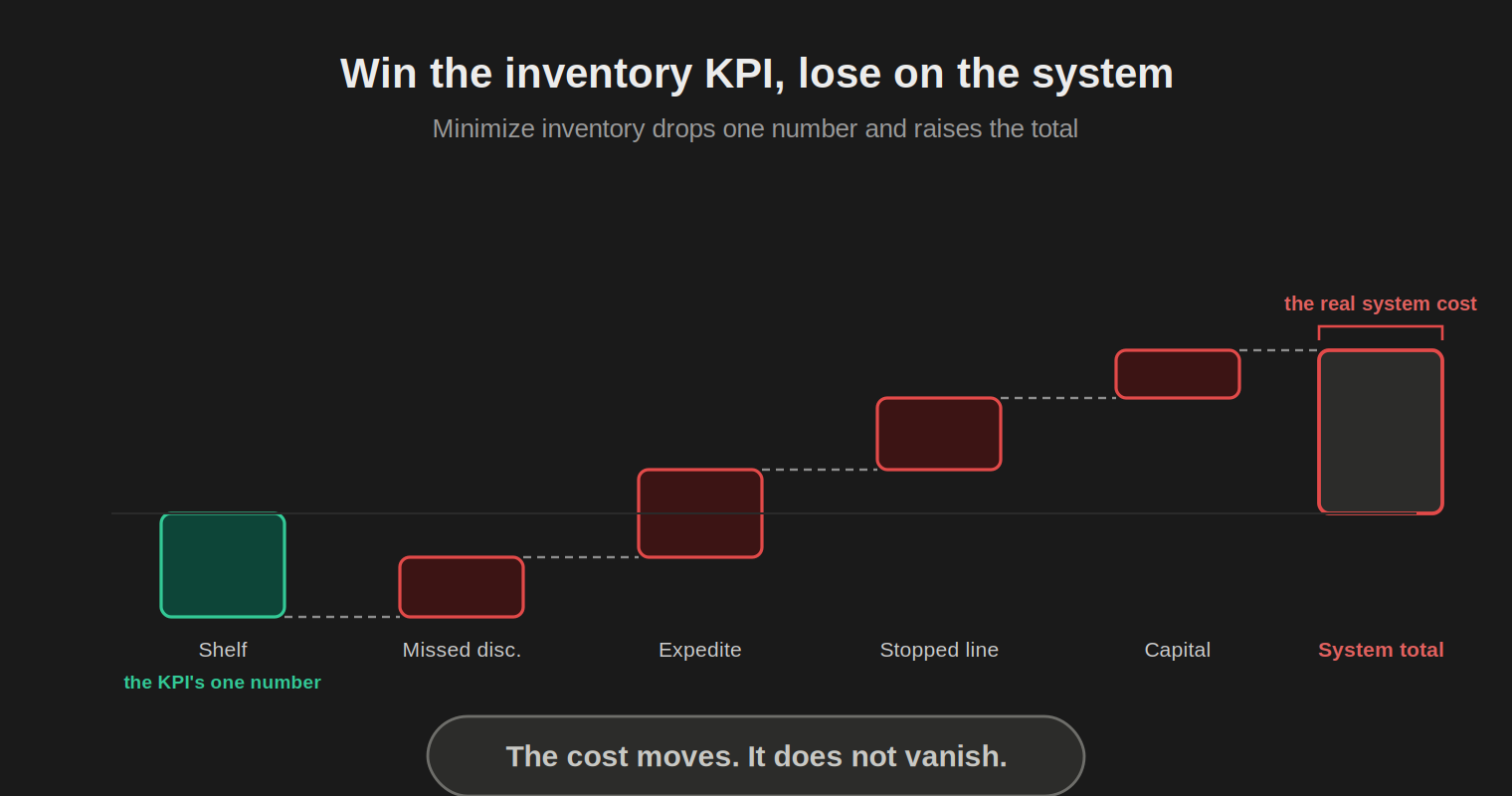
"Minimize inventory" is a local rule. It optimizes one number, the stock on the shelf, in isolation. The system you actually run includes purchase prices, supply risk, stockout damage, and the cost of capital, and the system's total cost is what the company pays. Push the local rule hard enough and you can win the inventory KPI while losing money: a missed discount that beat your cost of capital, or a line stopped for a $40 component.
Lean knows this, even when the slogan version forgets. The waste Taiichi Ohno attacked was stock that hides problems and stock nobody decided to hold; the system he built ran on calculated buffers, sized to demand and lead time, revisited when conditions changed. Hopp and Spearman later gave the principle its sharpest form in Factory Physics: variability in a production system will be buffered whether you plan it or not, and your only choice is the mix of inventory, capacity, and time. Refuse to hold the buffer and it reappears as overtime, expediting, and missed deliveries.
So the controller's job here is system arithmetic. The carrying cost prices one buffer. The discount, the price increase, and the line-down cost price the alternatives. Whichever combination costs the system least wins, and the verdict changes item by item. Article 5 made the same move on payables: the rule said never pay early, the calculation found the exceptions worth taking. The series conclusion will give that pattern a name.
Common pushback
"Carrying cost is a soft number. My CFO won't sign off on 25%." Then run it at the part you can defend. The capital cost alone, your real cost of money, sits around 8 to 15% for most industrial firms, and it's the one piece nobody can wave away. Even at a conservative 15%, the yearly discount above loses and the six-month pre-buy still flips. The point isn't precision to the basis point. It's that the shelf currently carries a price of zero, and any defensible number beats that. For a material deal, swap the 25% proxy for the SKU's incremental rate and the verdict gets sharper, not softer.
"Procurement already negotiates these discounts. This is their job." Procurement optimizes price, and they're good at it. The carrying cost is the one column that never appears on their quote, because it lands on a different line of a different statement weeks later. No one is taking procurement's job here. Finance is adding the column only it can price, the cost of capital. Run it together on the three biggest deals and it stops being a Finance-versus-Procurement conversation.
"Holding more inventory contradicts everything Lean taught us." It contradicts the bumper-sticker version. The actual target was stock that hides problems and stock nobody decided to hold. A buffer sized to a real lead time, priced, named, and reviewed is a calculated buffer, which is exactly what the system was built on. Factory Physics is blunt about the alternative: refuse to hold the buffer and variability buys it back as overtime and expediting, usually at a worse price.
"We can't put a review date on thousands of SKUs." You don't. You review the holds someone deliberately added a premium for, which is the small Keep pile, plus whatever lands on the red list. The prevention rule is one field filled in at creation, not a monthly audit of the whole warehouse. The point of pricing the buffer is that most SKUs never need the conversation. The few that carry a real premium are the ones worth a date.
What to do this week
You have the red list from Article 6. Now build the meeting.
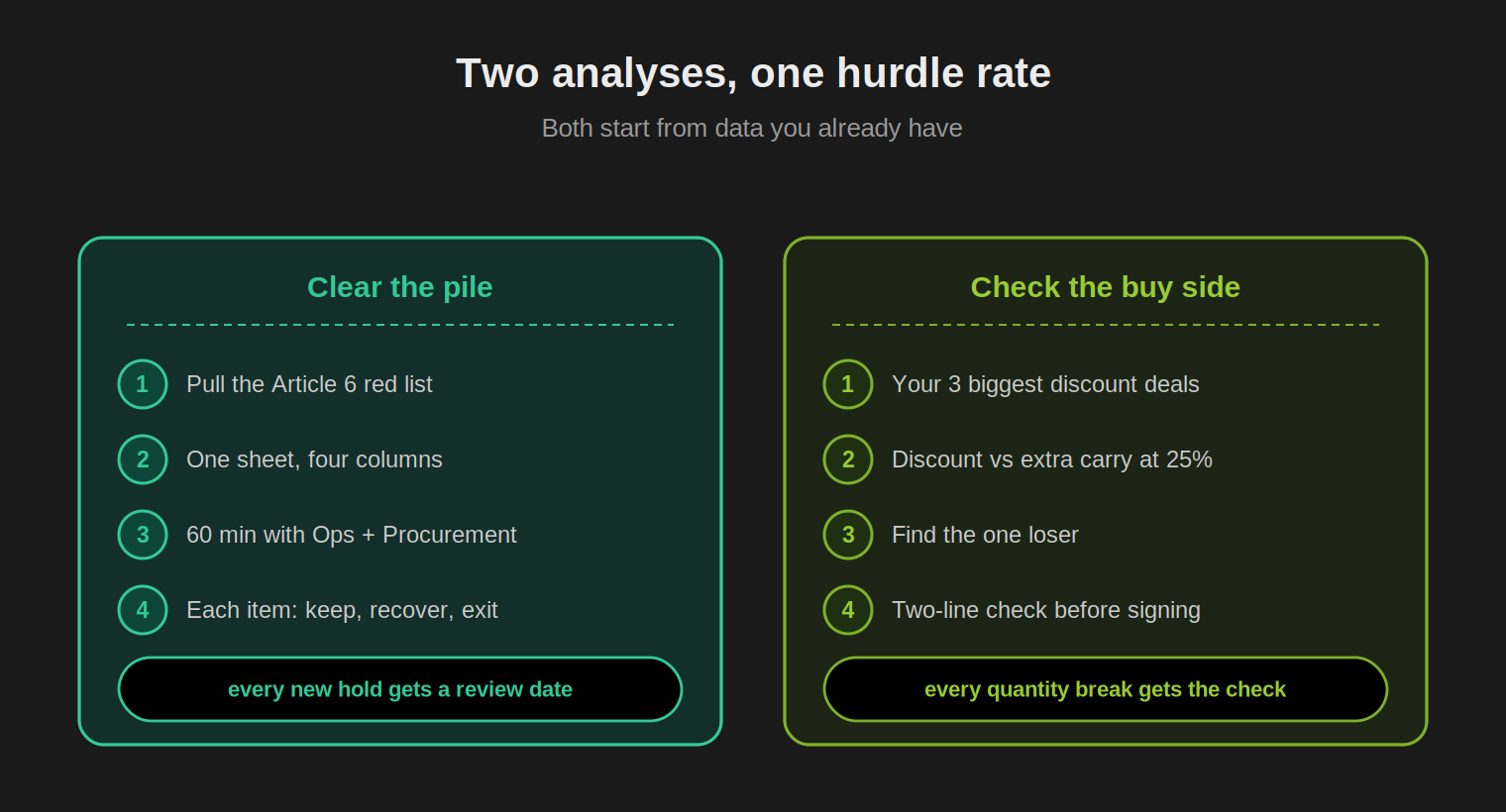
One spreadsheet, four columns per item: annual carrying cost (value times 25%), the claimed risk or return if anyone claims one, realistic recovery value, write-down impact. Send it to Operations and Procurement before the meeting, never during. Book 60 minutes. The agenda is one sentence: every item leaves with keep, recover, or exit, and a name attached. Set one rule before anyone leaves the room: every new deliberate hold gets a review date on the way in. The meeting clears the pile. The rule keeps it from refilling.
Then run the hurdle on the buy side. Pull the volume-discount deals Procurement signed this year, take the three largest, and run discount against extra carrying cost. If you find a loser, you've also found a friendly way to introduce the hurdle rate to Procurement: from now on, every quantity break gets the two-line check before signature.
Ask this next month: Which of our deliberate holds has a named risk, a priced premium, and an owner who would sign it again at today's carrying cost?
FAQ
How do I get Operations to actually show up to the red-list meeting? Send the priced list 48 hours ahead, and frame the meeting as "we price, you decide," not "Finance is scrapping your stock." Operations owns the keep call because they own the risks the stock covers. When the invite says the four columns are already filled in and the decision is theirs, attendance stops being the problem. The fight you want to avoid is the one where Finance shows up with a scrap list and no risk context.
What if Procurement won't run the carrying-cost check before signing a discount? Don't fight for the policy first. Run it yourself on the three biggest quantity-break deals already signed this year and find one loser. One visible deal that paid $27K to save $12K changes the conversation faster than any memo. Then propose the two-line check as a default field on the purchase requisition, so it happens by template instead of by goodwill.
Does carrying-cost-as-hurdle work for finished goods and spare parts, or only raw materials? It works across all of them, because the capital cost is the same wherever cash sits. What changes is the rest of the rate. Finished goods and slow-moving spares usually carry a higher effective rate, because obsolescence and shelf-life risk are larger, so the 25% proxy understates them. For those categories, lean toward the SKU's incremental rate rather than the flat number, and the bar to justify a hold gets higher, which is correct.
How do I tell deliberate safety stock from accidental dead stock when both sit still on the shelf? Movement history alone won't tell you, because a good buffer and a forgotten one look identical from the warehouse. The test is the four fields: a named risk, a named owner, a priced premium, and a review date. Then the renewal question: would anyone sign this hold again at today's carrying cost? If nobody will put their name on it at the current price, the label is the only thing keeping it, and that's the definition of accidental stock wearing a safety badge.
Where this goes next
The analysis behind this series (the segmented DIO view, the per-item movement split, the carrying cost per item, and the hold-evaluation math from this article) is what the Net Working Capital Operating Model course, CC-AA02, automates from a standard ERP export.
Article 8 closes the series: three levers on one page, a monthly review that starts from data, and the input check that keeps the whole gauge honest.
This article first appeared in the Practical Lean Finance newsletter on LinkedIn.
Sources
The Hackett Group, 2025 Europe Working Capital Survey (1,000 largest European-headquartered nonfinancial companies, 2024 performance). DIO up 4% to 68.9 days, the highest level in a decade, with roughly €1.4T in excess working capital; inventory buffers against supply chain and geopolitical risk named among the drivers.
Grant Thornton, "Cost management in 2026." Tariffs and supply chain frictions named among the top external risks shaping cost decisions, with sourcing and inventory responses proving more durable than the disruptions that prompted them.
NetSuite / ISM / APQC, inventory carrying cost components and the 25% planning shortcut (carried from Article 6).
IAS 2, Inventories. Inventories measured at the lower of cost and net realizable value; write-downs recognized as an expense in the period they occur.
Wallace J. Hopp and Mark L. Spearman, Factory Physics. The book that turned buffers into a law: variability will be buffered by some combination of inventory, capacity, and time, whether you plan the buffer or not. View on Amazon.
As an Amazon Associate, GoFast.Finance earns from qualifying purchases.