- Jun 14
A Bigger DPO Is Only Good News Once You Know How You Got It
- Arnaud Lemaire
- Accounting & Auditing
- 0 comments
This is the fifth piece in a series on working capital, and the second of two on what you pay your suppliers. Last week, You're Financing Your Suppliers for Free, showed how to read days payable outstanding honestly: on purchases rather than cost of goods sold, walked back month by month so growth and seasonality stop flattering the figure. If you are new here, start with the opener on where cash gets trapped across the cycle. This week picks up a promise that last article left open. There is a single moment when paying a supplier early beats every other use of that cash. The metric your scorecard tells you to push up is the same thing hiding it.
First the trap that keeps you from seeing it. The working capital scorecard says push DPO up. It is the lever you control, and a higher number reads as a win. But the highest DPO is rarely the best outcome. Pay one supplier early and the number drops, while you earn a return few other uses of that cash can match. Squeeze another and it climbs, right until that supplier fails and takes your line down with it. The real work sits one level below the number. Which supplier gets which treatment, and how you spot the ones worth paying early.
DPO is a proxy. It tells you how long your cash stayed. It cannot tell you whether staying was the right call. So the job is not to maximize it. The job is to put every dollar of payment timing where it earns the most, in cash and in the supplier relationships you depend on, and let the number settle where that decision leaves it.
Read the cause before you trust the number
Last week's article closed with a warning. A higher DPO can come from discipline or from drift, and the figure on its own cannot tell the two apart. Separating the disciplined rise from the cosmetic one is this week's job, and it has a shape. When DPO moves, the move has a cause, and there are only a handful of them.
Six reasons the number goes up or down:
You negotiated longer terms. Durable, and good.
You stopped paying early by accident. A free win, and good.
You took early-payment discounts. This pulls DPO down, and it is often the smartest thing you did all quarter.
You leaned on supplier finance or reverse factoring. This can be borrowing wearing a payables label, and it is a warning to read closely.
You paid late, or left invoices blocked in dispute. A squeeze or a process failure, and bad.
Your supplier mix or spend pattern shifted. Neutral, but you strip it out first so it does not get mistaken for any of the others.
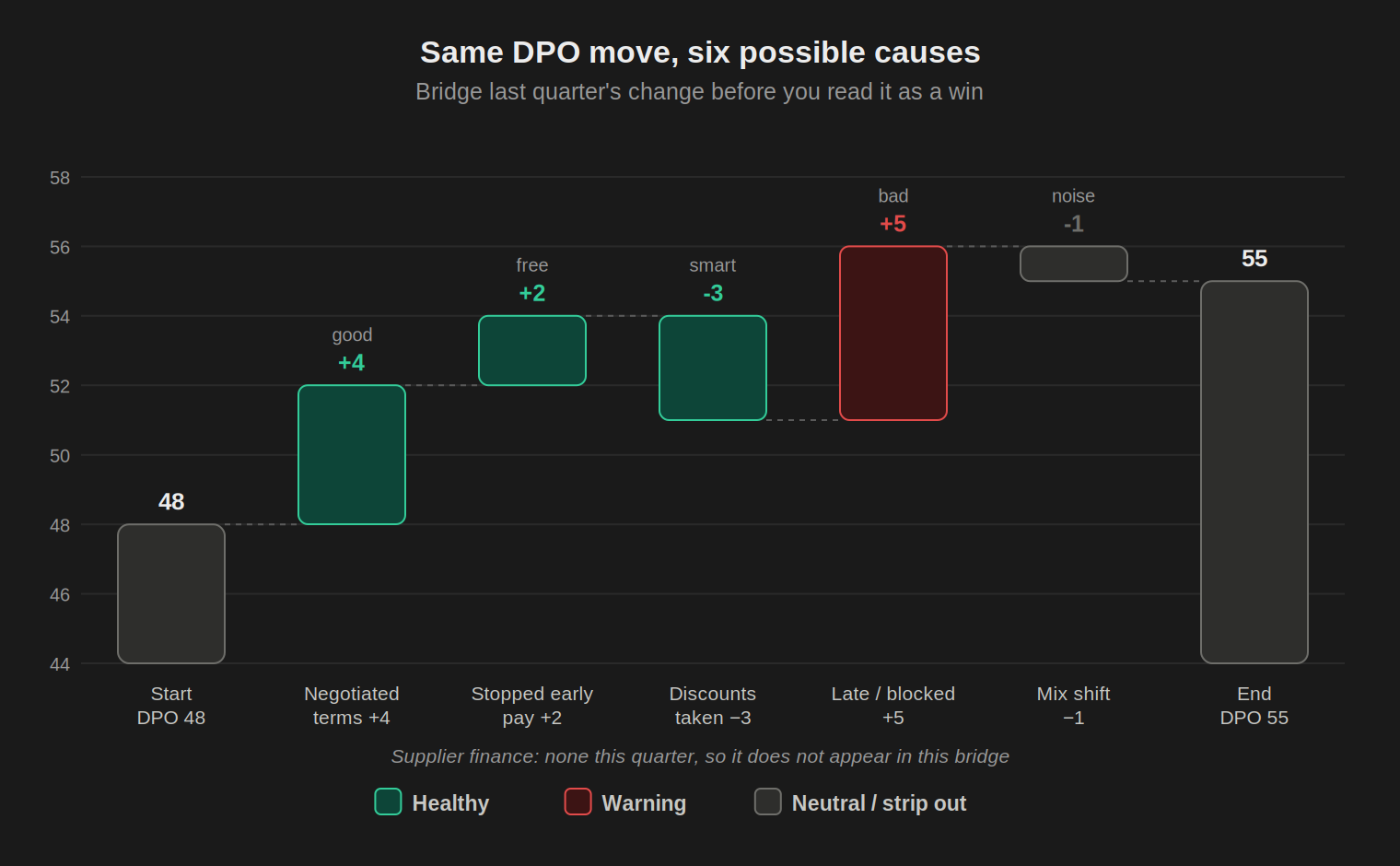
A DPO movement is a reconciliation item, not an answer. Bridge it before you celebrate it.
The first three are levers you pull on purpose, and they come next. The fourth and fifth are where the lever turns dangerous, and they come after that. The sixth is noise you clear out of the way before you read anything.
Put it on a number. Say DPO went from 48 to 55 last quarter, a seven-day rise the scorecard reads as a win. Bridge it. Negotiated terms added 4 days, stopping accidental early payments added 2, discount capture pulled 3 back off, mix took off 1, and late or blocked invoices added 5. The healthy moves account for six of the seven days. The other day is a process failure dressed up as discipline, and you only see it because you bridged it. The single figure hid a problem inside a result that looked good.
Three ways to move it on purpose
Stop paying early by accident
Most early payments are not decisions. The payment run clears everything that has been approved, the team reads "on time" as "before the due date," and cash leaves days ahead of when it is owed. Last week sized that cash. Recovering it is mostly configuration. Hold each vendor's terms in the system, filter the payment proposal to the invoices that actually reach their due date in the next run, and set the run cadence to match due dates instead of a blanket weekly sweep. This is standard in SAP and most major ERPs. The tool is rarely the hard part. The baseline dates, the vendor master terms, and the exception handling are. It lifts DPO without touching a single supplier relationship, because you are paying to the terms you already agreed, not a day past them.
Pay early when the discount beats your hurdle
This is the moment last week promised.
Take a common supplier discount, 2/10 net 30. Pay within ten days and you take 2% off. Otherwise the full amount is due on day thirty. Skip the discount and you have kept your cash for twenty extra days and paid 2% more for the privilege. Put an annual rate on that. The discount sits on the ninety-eight cents you actually hand over, and you are giving it up to hold the cash twenty more days:
(2% / 98%) × (365 / 20) ≈ 37%
Skipping a 2/10 net 30 discount is roughly a 37% simple annualized cost of trade credit, and higher still once you compound it. The exact convention matters less than the conclusion. It sits far above what cash costs almost any company.
Read it the other way and the reflex flips. Taking that discount earns about 37% a year on the cash, for the twenty days you moved it forward. No safe use of that cash on your balance sheet comes close. And here the metric and the money pull in opposite directions. A higher DPO says hold the cash to day thirty, or stretch it to forty-five. The economics say pay on day ten, take the 2%, and watch DPO fall. Follow the cash. The number dropping is the right outcome.
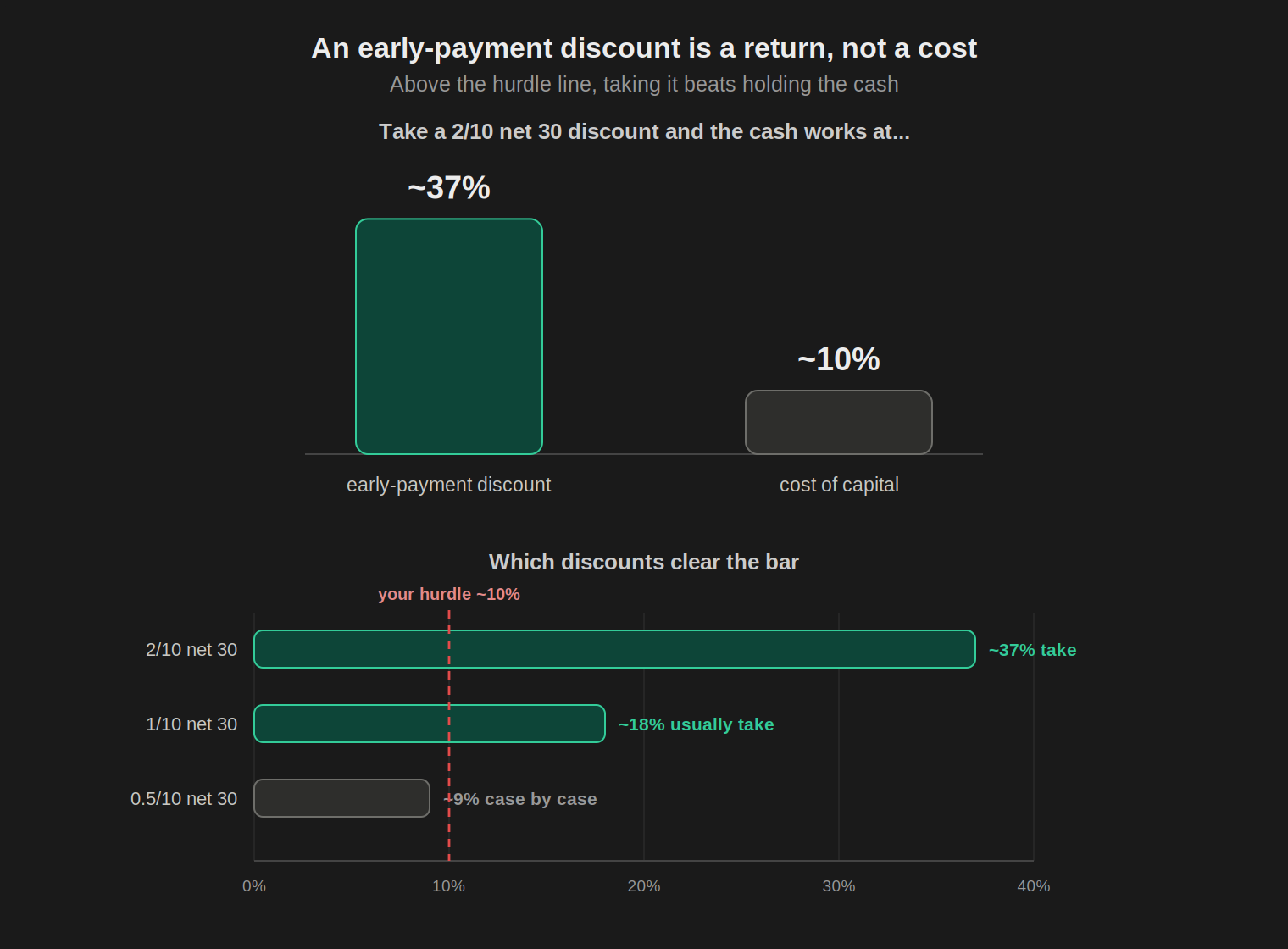
The annualized return on an early-payment discount usually dwarfs your cost of capital. The ladder shows where it stops being worth it.
One caution on the comparison. The hurdle is not your group WACC by default. Use the marginal cash alternative, what the same cash would earn, save, or avoid over those same twenty days. Your revolver rate. Your short-term borrowing cost. The return on paying down a facility. The next best use of liquidity you are currently rationing. WACC is a fallback when you have nothing sharper, not the right benchmark.
Which means not every discount is worth taking. Run the same arithmetic each time.
2/10 net 30 annualizes near 37%. Take it almost always.
1/10 net 30 annualizes near 18%. Usually take it.
0.5/10 net 30 annualizes near 9%. That is roughly cost of capital. Decide case by case.
A discount that annualizes below your hurdle is not worth chasing. Pay to terms and keep the DPO.
Put numbers on it. A manufacturer spends $40M a year with a group of suppliers offering 2/10 net 30, and today it pays them all on day thirty and takes nothing. Capture the discount and it saves 2% of that spend, $800K a year. The cost is that it now pays ninety-eight cents on the dollar twenty days sooner, so it carries about twenty days of that spend as extra cash out the door, roughly $2.15M on average. At a 10% cost of capital, carrying that early cash runs about $215K. Net, the company is about $585K a year better off, and its DPO on those suppliers went down to get there. The team that had been rewarded for pushing DPO up was walking past more than half a million dollars to do it.
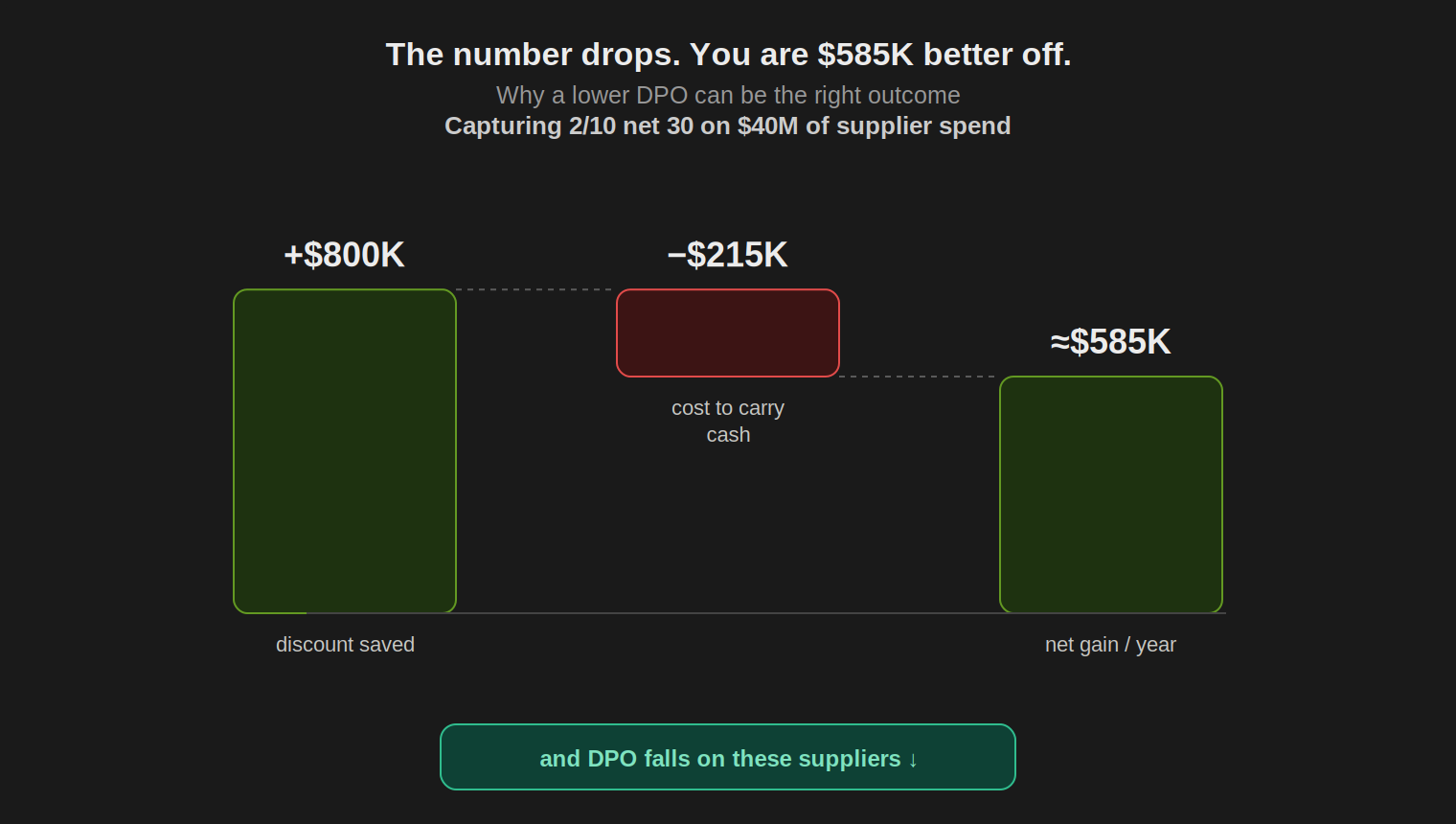
Capturing the discount on $40M of spend nets roughly $585K a year. The DPO drop is the price of collecting it, and it is worth paying.
The supplier-by-supplier numbers in this article come from payables reviews I ran across earlier manufacturing finance roles, rebuilt as a refreshable view for the Net Working Capital course on GoFast.Finance. The pattern repeats almost everywhere: a team measured on a single DPO target, quietly leaving discount money on the table to protect it.
Negotiate longer terms
The clean way to lift DPO is to renegotiate the terms, not to quietly pay past the ones you have. Move a supplier from net 30 to net 60 and DPO rises permanently, with the supplier's agreement, and nothing is breached. It is durable, and it is clean only if the longer term is genuinely free. Check that procurement did not buy it back in the unit price, the freight, the minimum order, or a quieter drop in service, because a term you paid for in the price is not a win. Check too that it is within local rules. In the EU, for example, B2B terms generally run to a 60-day ceiling unless both sides expressly agree more and it is not grossly unfair to the supplier. What you can actually negotiate depends on who needs whom, which is the next problem. You can push a commoditized supplier with three replacements down the road. You cannot push the sole source who could walk away and leave you with a dark production line.
What you are really doing has a name
Step back and the three moves share one logic. Every supplier has a payment date that is economically right, the one that takes any discount worth taking, holds the cash you should hold, and keeps the relationship intact. Miss it in either direction and you pay for it. Quality engineers call this the cost of quality, and it splits four ways.
Prevention, the cheapest and the most skipped: clean terms in the system, a payment calendar built on due dates, a policy for which supplier gets which treatment.
Appraisal, the part most teams do instead: a monthly review of the top suppliers, a discount-leakage report, a watch on payment-to-terms drift.
Internal failure, caught inside finance: the accidental early payments, the missed discounts, the wrong terms in the ERP.
External failure, escaped to the floor: the late fee, the supplier in distress, the stopped line, the emergency buy from a vendor you squeezed.
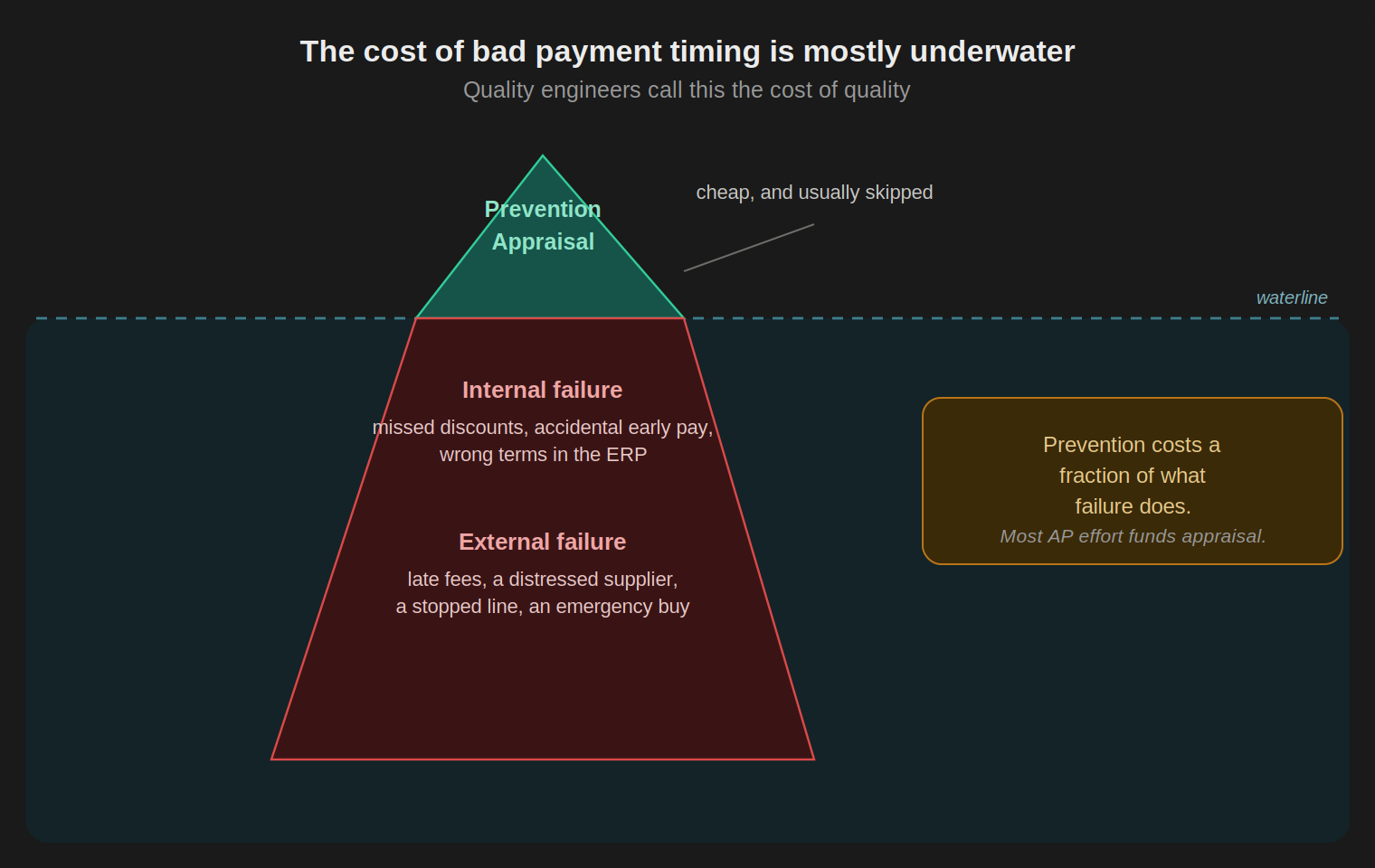
Most of what bad payment timing costs you sits below the waterline. Prevention is the cheap part almost everyone skips.
Prevention costs a fraction of what failure does, yet most AP effort funds appraisal and lets the failures run. Fund prevention instead, and DPO becomes the readout of payments that are already in spec.
Which supplier gets which treatment
A single DPO target aimed at every supplier treats the sole source you cannot replace and the commodity vendor you could swap tomorrow as the same lever. They are nothing alike, and the gap between them is where both the money and the risk live.
Start with the biggest, because a handful of suppliers usually carry most of what you buy, and that is where the effort pays. Then sort them on a few axes before you act. How critical they are, sole-source and slow to requalify, or commoditized and switchable. How fragile, meaning whether they can absorb a longer payment without it threatening their own survival and so your supply. Whether they offer a discount worth capturing. Who holds the bargaining power. How much it would cost you if they stopped shipping. The discount-bearing suppliers and the accidental early payments are where the savings sit. The critical and fragile ones are where a careless push does the most damage. The sort is also how you find the cost-reduction opportunities in the first place, because they are not spread evenly across the supplier base, they cluster.
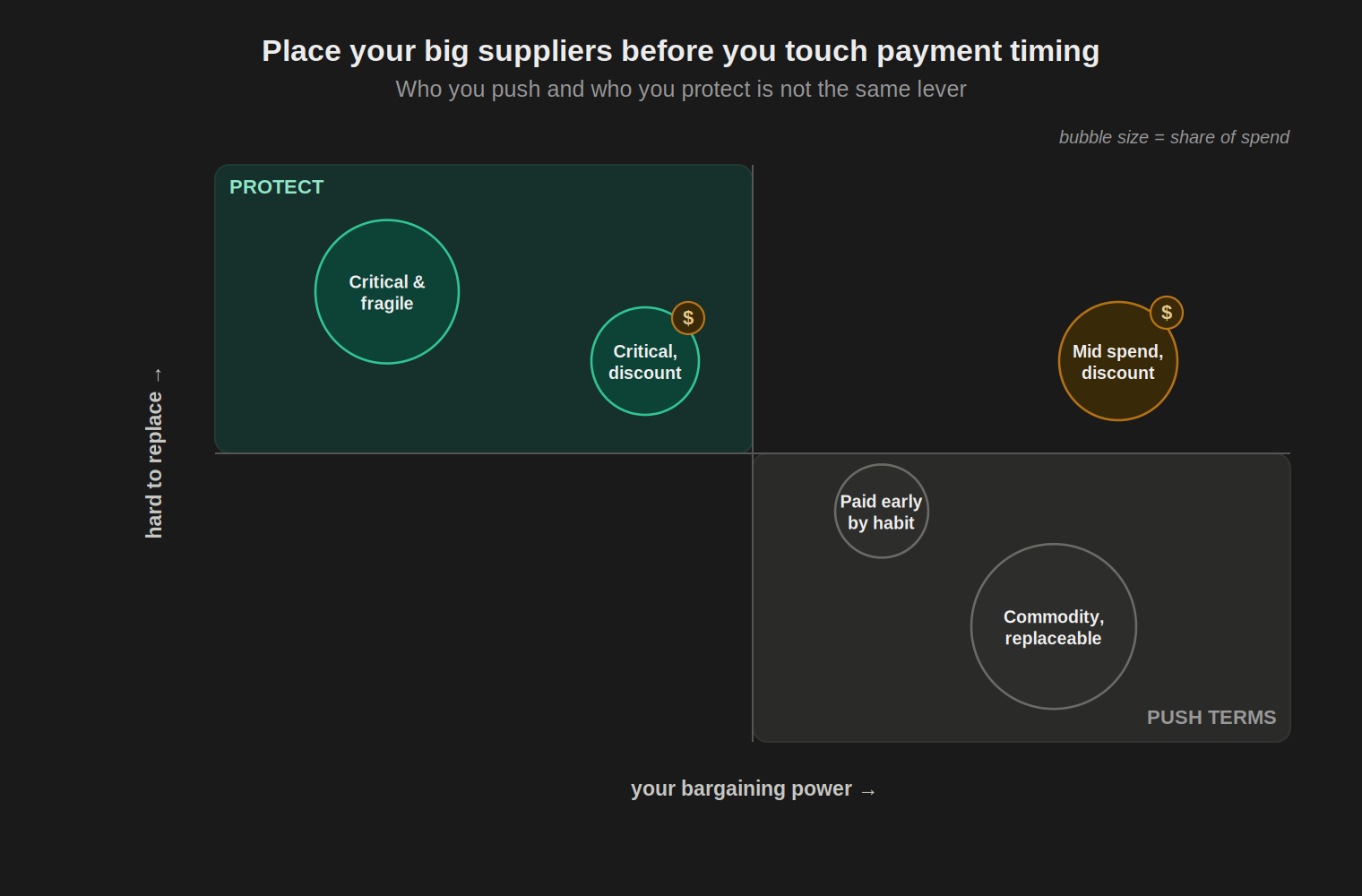
Before you touch payment timing, place each big supplier by how replaceable they are and how much leverage you hold. The picture tells you who to push and who to protect.
That sort turns into four plays.
The supplier What you do Where DPO goes Critical and fragile, no discount on offer Pay to terms, sometimes early, to keep them standing Flat or down, deliberately Offering a discount that beats your hurdle Pay early and bank the return Down, correctly Commoditized, replaceable, you hold the cards Negotiate longer terms Up, durably and cleanly Paid early today out of habit Stop the accidental early payment Up, for free
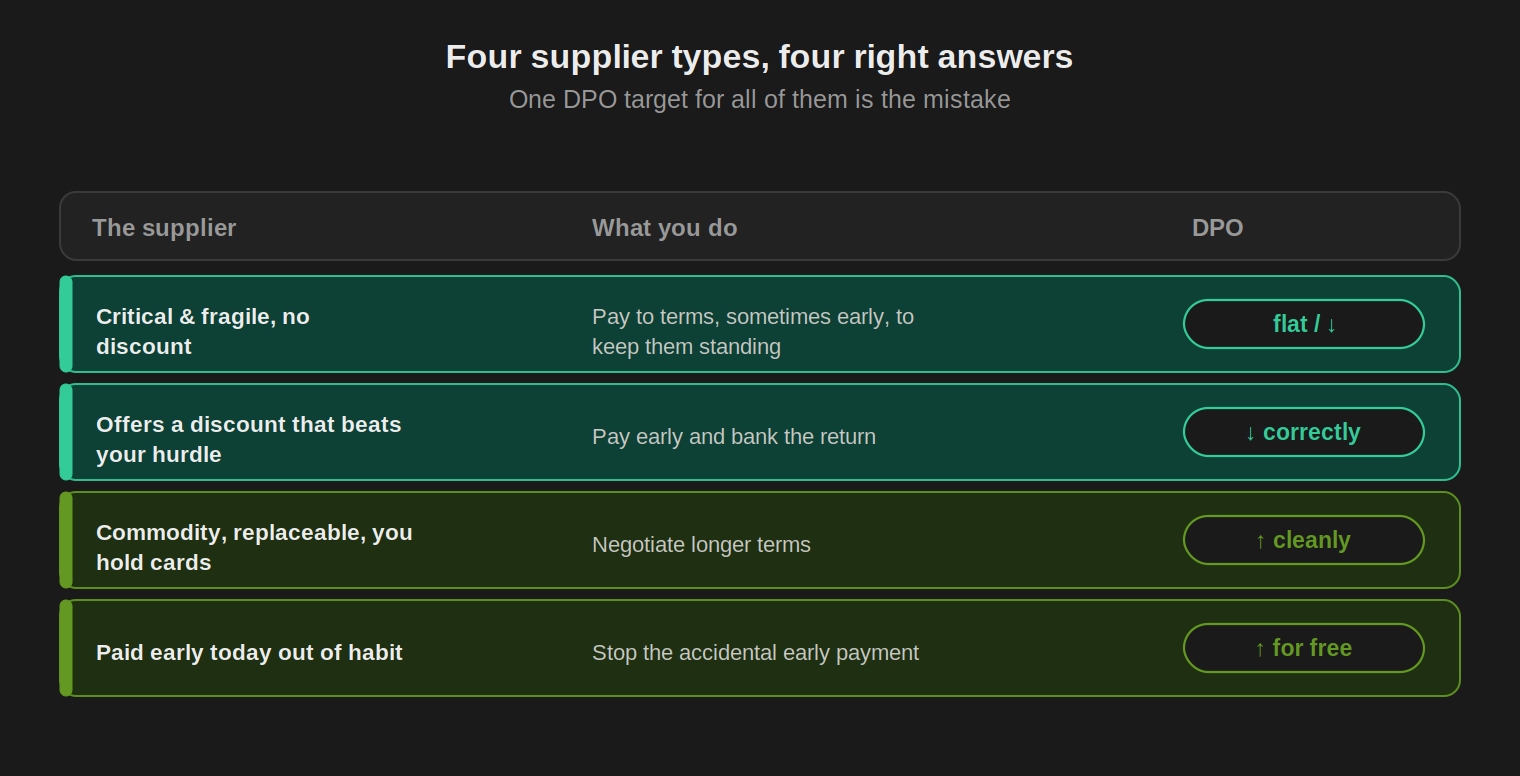
One target for every supplier is the mistake. Four supplier types, four different right answers, and DPO moving in different directions on purpose.
Take a plant that runs one specialty component through a single supplier, fourteen weeks to qualify anyone else, on a balance sheet you would not want to lean on. It buys generic fasteners from three vendors who are interchangeable. A drive to hit one DPO number stretches both. The fastener vendors absorb it without a flicker. The specialty supplier, already short on cash, slips a delivery, and the line goes down. The DPO chart looked better for exactly one month. The cost was a stoppage on the one relationship with no backup anywhere. Segment first and the call is obvious. Stretch the fasteners, protect the specialist.
Where a rising DPO turns dangerous
Last week named the bad reasons a DPO can climb. Two of them matter most. The first is the squeeze. Stretch suppliers past the terms you agreed and nothing actually improves. You have just moved your financing problem onto them, usually onto the smallest, who are least able to absorb it and sometimes do not survive it. Paying past terms and paying to terms produce the same DPO with opposite consequences, which is the whole reason you read what created the number.
The second can hide inside the number itself. Reverse factoring, also sold as supply chain finance, has a bank pay your supplier early while you repay the bank later, often on longer terms than the supplier ever gave you. Your DPO stretches and your supplier is content. Whether the financed balance stays in trade payables, moves to a separate line, or counts as borrowing depends on the substance of the arrangement, not the label, and the accounting can land any of those ways. The test that matters to you is simpler. Would the cash benefit survive if the financier walked away. When it would not, you are looking at borrowing wearing a payables label, however it is booked.
Watch how it works on real numbers. Take a manufacturer with $120M of annual spend across its largest suppliers, sitting on net 45 terms, so its DPO on that spend runs around 45 days. It sets up a supply chain finance program. The bank pays the suppliers at day ten, the suppliers are happy, and the manufacturer now settles with the bank at day ninety. DPO on that spend roughly doubles to 90 days. Those extra forty-five days free about $15M of cash, which the company reports as a working capital win. The catch is where the $15M lives and how fast it can turn around. While the program runs, reported borrowings barely move and the leverage ratios the bank covenants watch look unchanged. Then the facility unwinds. The bank pulls it on a covenant breach, or the credit insurer behind it withdraws, the way Greensill's did. New invoices stop being funded at once, confirmed balances run off on their agreed dates, and the suppliers start asking for their original net 45 back. The company has to replace that payment-term bridge as the balances mature, and the squeeze can arrive fast if it was leaning on the extension. The DPO that read as discipline slides back toward where it started. The number was healthy. The cash was real. It was financing the whole time, and it was reversible at someone else's discretion.
This is why a supplier finance program needs a standing stress test, not an annual one. If the facility vanished tomorrow, how much cash would you need over the next 30, 60, and 90 days to keep suppliers paid and lines running. If you cannot answer that in a meeting, the program is running you.
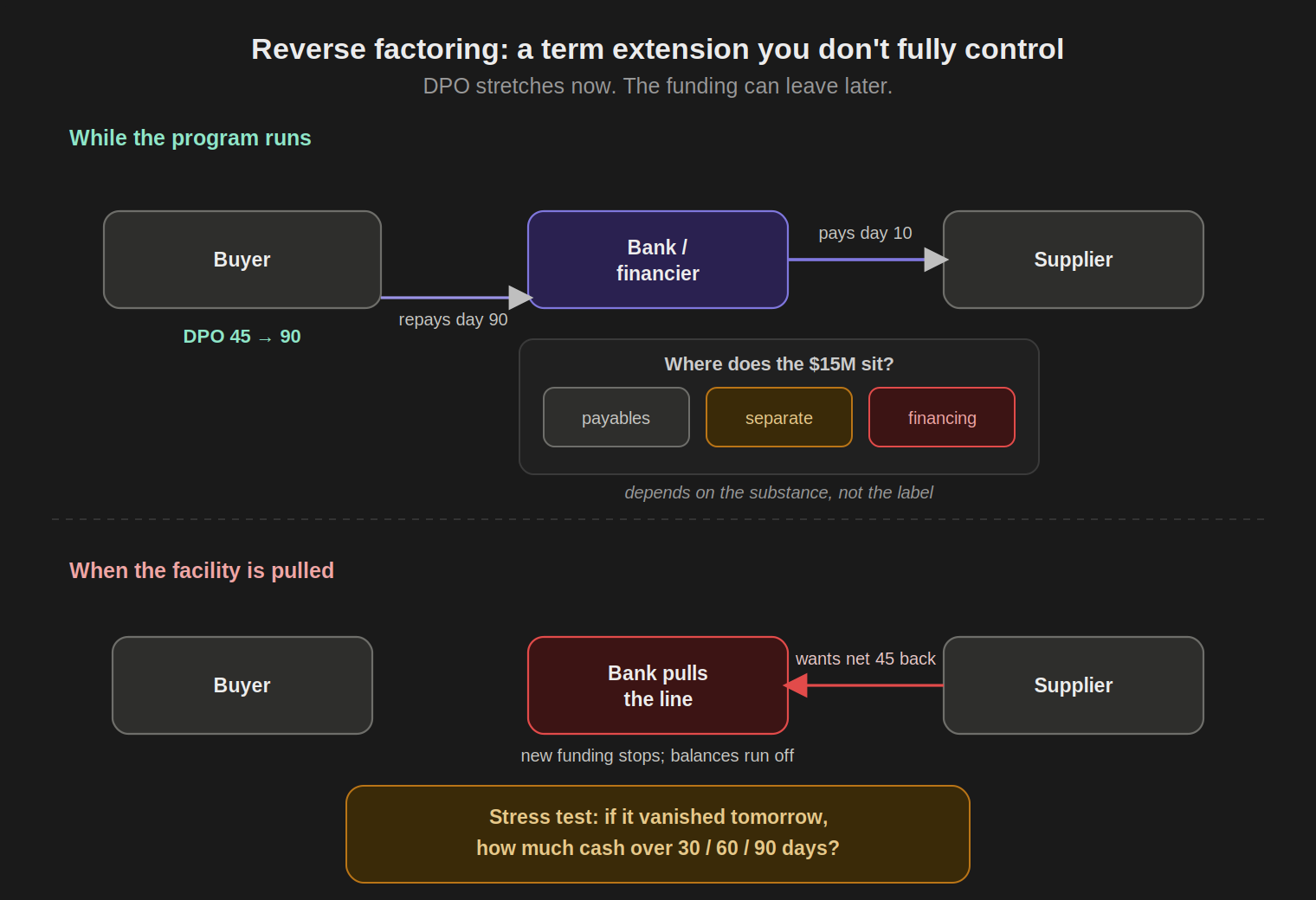
Reverse factoring can stretch DPO while the balance stays in payables, is shown separately, or counts as financing, depending on the substance. The test that matters: when the facility is pulled, the funding leaves and the term extension has to be replaced.
Carillion is the case to remember. The UK parliamentary inquiry into its 2018 collapse found it had pushed suppliers onto 120-day terms and run an Early Payment Facility through major banks. Moody's argued as much as £498M of the resulting obligations sat outside reported borrowings, while the company's own audit committee papers put the drawn amount nearer £472M, and the Financial Reporting Council did not confirm whether it agreed with the rating agencies' accounting view. The disagreement is the point. Classification turned on the precise terms, and the economic risk stayed hidden from most readers while the argument ran. One arrangement flattered the DPO and the balance sheet at once, until it stopped. Greensill, in 2021, showed the other half of the risk, that the financier itself can fail and take the funding with it.
The rules have since caught up on both sides of the Atlantic, along parallel paths rather than identical ones. FASB's ASU 2022-04 under US GAAP, and the targeted amendments to IAS 7 and IFRS 7 under IFRS, now require buyers to disclose these programs, their terms, the amounts outstanding, where the liability sits, and the liquidity risk if the financing vanished. They are not the same rule, but they pull the same direction. Neither reclassifies the balance as debt for you. They force visibility. Whether it is really a payable or really borrowing still turns on the substance of the arrangement, and that stays your judgment to make and defend.
What good looks like, and why you cannot copy it
For context, not for targets. The Hackett Group's 2025 work puts the average DPO of the largest US companies near 59 days, on a cash conversion cycle around 37, and the strongest performers run their payables longer than that. In Europe the average DPO sits closer to 73 days, on a cash conversion cycle near 45. The spread between the two is the lesson on its own. There is no single right DPO. It depends on your industry, your supplier mix, your terms, and how much of your spend carries a discount worth taking.
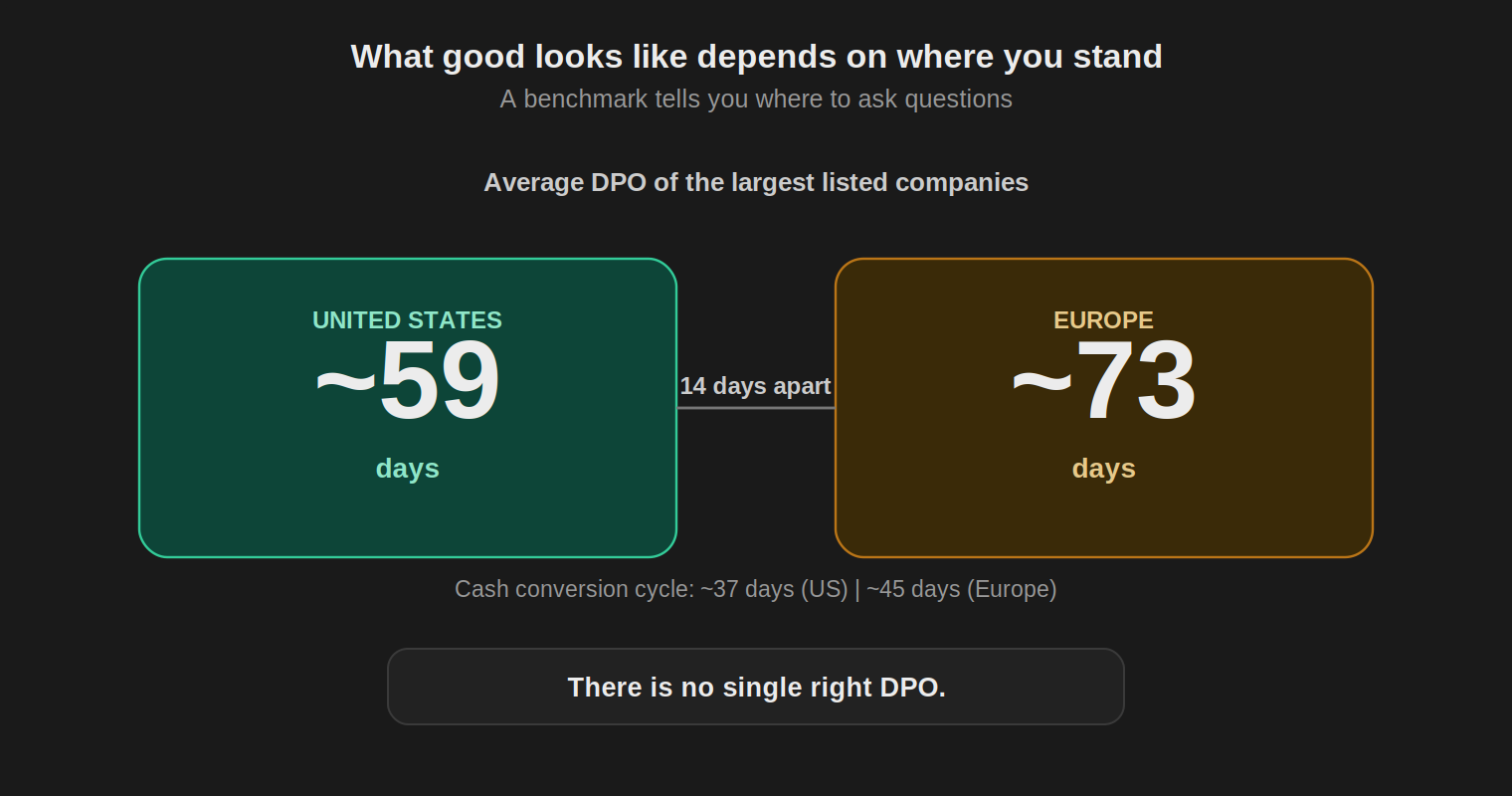
US and European averages sit fourteen days apart. The spread is the point: a benchmark tells you where to ask questions, not what your DPO should be.
Benchmarks tell you where to ask questions. They do not tell you what your DPO should be.
Why this matters: read DPO quality, not DPO level
None of this works if you read DPO on its own. The number cannot tell you whether your payables are well run. A DPO of 60 built on missed discounts and a sole-source supplier you have squeezed is a weaker position than a DPO of 45 where you captured every discount worth taking and hold long, clean terms with the suppliers that carry most of your spend. Same level, opposite quality. The single figure scores none of that.
So read payables on three things at once, and aim them where the money is. The days, DPO read honestly through the bridge. The discounts, the cash you earned by capturing the ones that beat your cost of capital. The terms, how much of your largest spend sits on payment terms you actually negotiated. Underneath the days sits the measure that makes them honest, payment-to-terms: of what you paid, how much landed in the discount window, how much on the due date, how much early for no reason, and how much late or blocked. The bridge tells you what a single month's move was made of. These readings tell you whether the run of them is going your way.
One line in that scorecard moves nothing on its own, because no single function controls payables. AP runs the payment timing. Procurement owns the negotiated terms. Treasury owns the liquidity that decides whether you can fund a discount. Operations owns which suppliers you cannot afford to lose. A DPO target handed to AP alone, with no owner for the other three, rewards the one move that loses money. A small number of suppliers carry most of what you buy, and that group is where all four functions and all three readings pay off. Read the number there, supplier by supplier, and the DPO you end up with is one you can stand behind, because you know exactly how you got it.
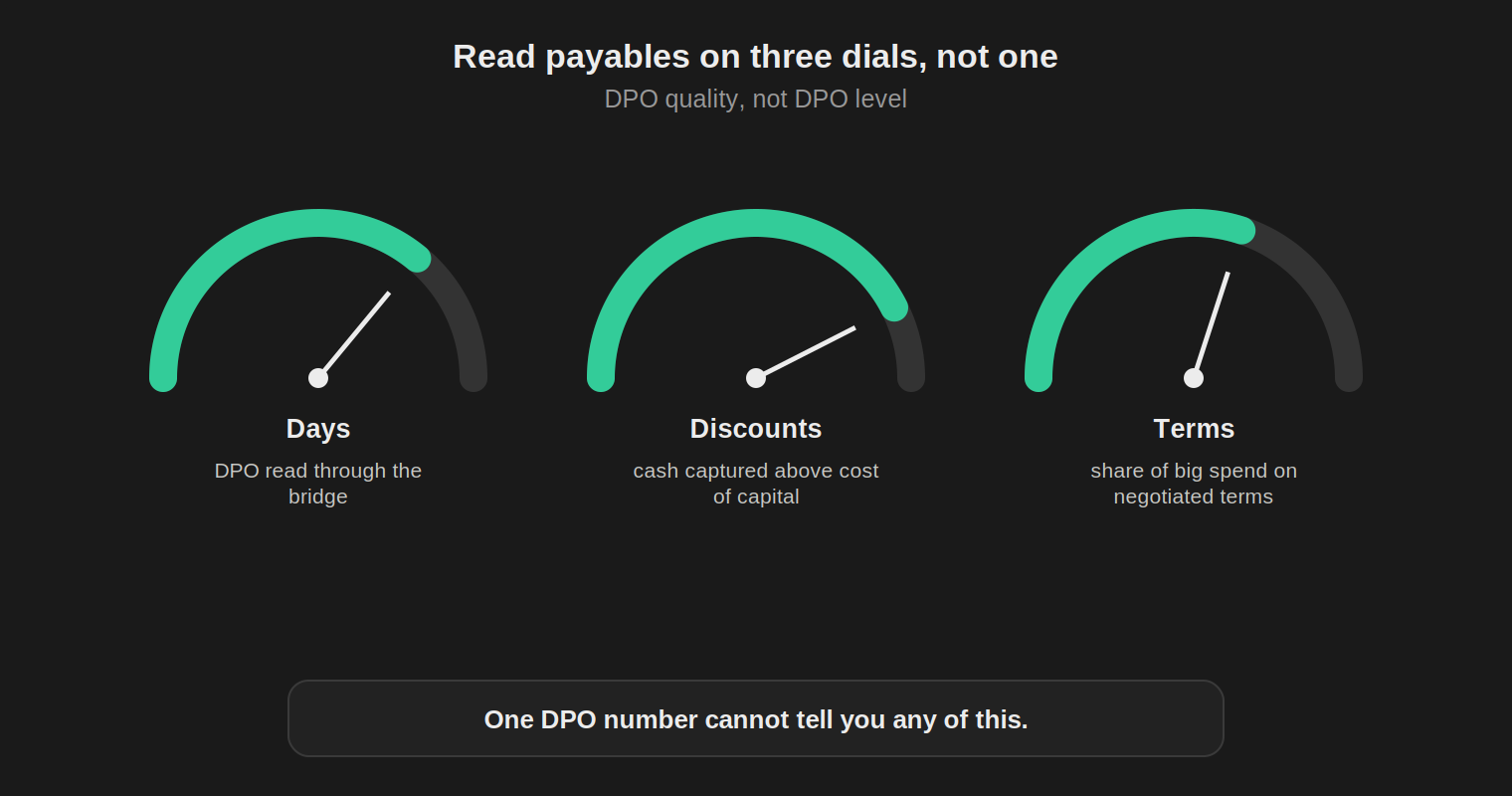
A single DPO figure scores none of what matters. Read days, discounts, and terms together, on the suppliers that carry most of your spend.
Common pushback
"Our treasury sets a DPO target and finance is measured on it. I can't just let the number drop." You can if you bring the economics with you. The target rewards the number; reframe the conversation around what the number cost to hit. Show the discount capture you walked past to protect the target, in dollars, and the conversation changes. The fix is usually to measure discount capture and payment-to-terms alongside DPO, so the scorecard stops rewarding the one move that loses money.
"Taking discounts means giving up cash we genuinely need for liquidity." Only if your marginal cost of cash is higher than what the discount yields. If you are rationing liquidity at 12% and a discount annualizes at 37%, taking it is the cheapest liquidity you have, not a drain on it. If you truly cannot fund the early payment, that is a financing problem to name out loud, not a discount to skip quietly while reporting a healthy DPO.
"Reverse factoring is normal. Every large company runs a program." Usage is not the problem. Dependency and disclosure are. A program is fine if you would survive the facility vanishing tomorrow and you disclose it honestly under the new rules. The danger is treating it as free, permanent term extension and letting the financed balance hide in payables until the day it cannot.
"We don't have the data to do this supplier by supplier." You do. It is in your AP ledger and your vendor master. For each invoice you can pull vendor, spend, the terms on the purchase order and in the vendor master, the baseline date, the due date, the clearing date, any payment block and its reason, the discount offered and whether you took it, and the payment run that cleared it. Add a criticality flag and a supplier finance flag by hand for the top names. The top ten suppliers by spend is one export and a few added columns, not a system project. Most of the cash and most of the risk sit in that group, so you do not need the whole base to start. You need the ten that matter.
Closing the lever
That same group of large suppliers is where next week starts. The conversation does not stop at when you pay them. Buy more at once and the unit price usually drops too. That discount is real, and it works by pulling cash into the warehouse, the opposite direction from the one you just worked on payables. Buy on sixty-day terms but in volumes that sit in stock for months, and the cash you freed is quietly tied up again. Add what it costs to land the goods at your door, and the right quantity to order stops being a question about unit price alone. The days, the early-payment discount, the volume break, the order quantity, and the inbound freight are one decision, and that is what the cash conversion cycle was always pointing at.
For three weeks the levers have come one at a time. Receivables, then the payables number itself, then the decisions behind it. Next week the third lever, inventory, in That's Not Safety Stock. That's Trapped Cash., where cash hides in plain sight as stock nobody quite decided to hold, and where the right quantity matters as much as the right price.
Ask This Next Month
For our ten largest suppliers, what terms did we actually agree, what are we actually paying to, and are we skipping any early-payment discount that beats our marginal cost of cash?
Controller Move
Pull accounts payable by supplier. For the top ten by spend, add columns: the terms you agreed, the average days you actually take to pay, the discount on offer and whether you take it, any payment block, whether a supplier finance balance sits behind them, and whether you could replace the supplier or not. Then take last quarter's DPO movement and bridge it into the six causes, negotiated terms, accidental early payments stopped, discounts taken, supplier finance, late or blocked invoices, and mix. Bring that bridge to the monthly working capital review, not a single DPO number. One honest pass almost always turns up a discount worth capturing and a fragile supplier you should stop stretching. That is your starting list.
Frequently asked questions
How do I get procurement to prioritize capturing early-payment discounts? Lead with the annualized number, not the percentage. A 2% discount sounds small to a buyer focused on unit price. A 37% annual return on the cash, against a cost of capital near 10%, does not. Put the dollar figure on last year's missed discounts across the top suppliers and bring it to the same meeting where DPO targets get set. Procurement does not own the payment run, so the lasting fix is a shared view that shows discount leakage next to the DPO number both functions are judged on.
What if a critical supplier refuses to extend terms? Then you do not extend them, and that is the right answer. A sole source you cannot requalify for fourteen weeks holds the leverage, and pushing terms onto a supplier already short on cash buys you a few days of DPO against the risk of a stopped line. Pay them to terms, sometimes early if their balance sheet is fragile, and find your DPO gains on the commodity suppliers who have replacements and can absorb the wait. Save the term negotiations for where you hold the cards.
Does this discount math work for a small business, or only large manufacturers? The arithmetic does not care about your size. A 2/10 net 30 discount annualizes near 37% whether you spend $40M or $400K. The hurdle changes, because a small business often has a higher and more painful marginal cost of cash, which makes the take-or-skip call sharper rather than softer. If your only alternative is an expensive credit line, the discount has to clear that line's rate, and the comparison is the same one a large company runs, with bigger stakes per dollar.
How do I tell the difference between a healthy DPO increase and stretching suppliers? Bridge the movement into its causes before you judge it. A rise from renegotiated terms, with the supplier's agreement, is durable and good. A rise from stopping accidental early payments is free and good. A rise from paying past agreed terms, from blocked invoices sitting in dispute, or from a supplier finance program quietly extending you is the warning sign. Same number, opposite meaning. The test is whether you can name the cause and defend it to the supplier whose cash it affects.
This article originally appeared in the Practical Lean Finance newsletter on LinkedIn. Read the weekly piece here.
The Net Working Capital Operating Model course (CC-AA02) on GoFast.Finance turns this into a refreshable payables view, with discount capture, payment-to-terms, and supplier segmentation built in.
Sources
The Hackett Group, 2025 US and European Working Capital Surveys. The US survey of the 1,000 largest public companies reports a cash conversion cycle near 37 days and average DPO near 59 days, with payables leading the recent improvement and top-quartile performers running DPO above the median. The European survey of the 1,000 largest companies reports a cash conversion cycle near 45 days and average DPO near 73 days. Used here only as context for the spread between markets, not as a target.
Early-payment-discount economics (2/10 net 30). The cost of skipping a discount is the discount over the net amount paid, scaled to a year: (2% / 98%) × (365 / 20), about 37% on a simple annualized basis, and higher compounded. The convention is standard in corporate finance texts (for example, OpenStax, Principles of Finance, on trade credit), which note the high implied annual cost of passing up such discounts.
FASB ASU 2022-04, Liabilities, Supplier Finance Programs (Subtopic 405-50). Requires the buyer in a supplier finance program to disclose the program's key terms, the amount of confirmed obligations outstanding, where they sit on the balance sheet, and a rollforward. Effective for fiscal years beginning after 15 December 2022, with the rollforward a year later. The standard changes disclosure only, not recognition, measurement, or presentation (per Deloitte's summary).
IASB amendments to IAS 7 and IFRS 7, Supplier Finance Arrangements. Require disclosure of the arrangement's terms, the carrying amounts including the portion already paid to suppliers by finance providers, the range of payment due dates, and related liquidity risk. Effective for annual periods beginning on or after 1 January 2024. Like the FASB rule, it addresses disclosure rather than classification.
IFRS Interpretations Committee, agenda decision on reverse factoring (December 2020). Confirms there is no automatic answer on presentation. Whether a reverse-factoring liability is shown within trade payables, on a separate line, or as other financial liabilities depends on its nature, function, amount, and timing, and on whether it still behaves like a normal operating payable. The Committee also highlights the liquidity risk created by reliance on extended terms and the possibility that a provider withdraws when the buyer is under stress. Source of the article's "substance, not label" framing.
Carillion (2018). The UK Parliament's inquiry into the collapse described an Early Payment Facility run through major banks alongside extended supplier terms. Moody's argued as much as £498M of the resulting obligations sat outside reported borrowings, while audit committee papers put the drawn amount nearer £472M, and the Financial Reporting Council did not confirm whether it agreed with the rating agencies' accounting assessment. Used as the worked illustration of supplier finance flattering both DPO and the balance sheet, and of how contested the classification can be.
Greensill Capital (2021). UK Treasury Committee material and trade-finance coverage (Global Trade Review) reported that the provider collapsed after roughly US$4.6bn of credit insurance behind its programs lapsed around 1 March 2021 and was not renewed, that it stopped originating new assets the following day, and that administrators were appointed within the week. Used as the illustration of provider dependency, distinct from the buyer-accounting problem.
EU Late Payment rules (B2B). EU rules on combating late payment in commercial transactions generally treat 60 days as the ceiling for B2B payment terms unless the parties expressly agree otherwise and the longer term is not grossly unfair to the creditor. Cited only to support the legal caveat on extending terms for a global audience; check local rules and the live state of the directive's revision.
SAP automatic payment run. SAP learning material describes the automatic payment program analyzing open items by due date, applying payment terms and payment blocks, and generating a payment proposal for review before posting. Cited only to support the claim that paying to terms is a configuration task in SAP, with master data and exception handling as the real work.
Karen Berman and Joe Knight, Financial Intelligence, Revised Edition: A Manager's Guide to Knowing What the Numbers Really Mean. Background reading for non-finance colleagues on the cash conversion cycle, payables, and hurdle-rate thinking that sit behind this article. View on Amazon.
As an Amazon Associate I earn from qualifying purchases. Book links above are affiliate links; using them costs you nothing extra and supports this newsletter.
#accountspayable #workingcapital #treasury #cashflow #finance