- Mar 21
SIPOC: The Lean Six Sigma Tool That Should Be Your First Move in Finance
- Arnaud Lemaire
- Accounting & Auditing
- 0 comments
Most finance teams run their month-end close without a process map. Some don't even have a checklist.
The numbers back this up. The median close cycle sits at 6.4 days across 2,300 organizations (APQC, 2017). Half of finance teams take 6 or more business days to close (Ledge, 2025). And 81% of accounting professionals say the monthly close disrupted their personal lives in the past year (FloQast/UGA, 2022).
Only 30% of companies have a documented close checklist. Not a process map. A checklist. And we wonder why it takes so long.
In twelve years of manufacturing finance, I've met more Lean Six Sigma belts than I can count. Green, black, every color. The conversation always goes the same way.
"Are you certified?" Yes. "Do you apply the methodology?" Well, not really by the book.
Not by the book. You studied DMAIC, you learned the process mapping tools, you paid for the certification, and now you don't use any of it? That's like passing your driving test and deciding you'll just wing it from now on.
I won't go into why certifications became resume decorations. That's a separate conversation. What I want to talk about is what it looks like when you actually open the book. Starting with the one tool that should come before everything else.
Why not "just use AI"?
If you're thinking "we don't need process mapping, we can just ask AI to improve our operations," try it.
Prompt it. "Improve my AP process." You'll get a confident, well-structured answer about automating three-way matching and implementing continuous monitoring. It has nothing to do with your AP process. AI tools predict the next likely word based on patterns. They don't know that your consolidation accountant spends four hours every close pulling intercompany data from three ERPs because nobody standardized the elimination entries. They don't know your accruals are late because Procurement never sends PO data on time.
And if your plan is to bring in a third-party vendor to connect AI to your systems? Go ahead. It'll cost you a fortune, they'll force you onto their processes, their platform, their ecosystem. You're locked in. Somebody will have to untangle all of that, peel off the duct tape, and reintegrate in two years. I know because I've been that person.
You can't improve a process you haven't mapped. Let's get back to the work.
What is SIPOC?
SIPOC stands for Supplier, Input, Process, Output, Customer. It's a Lean Six Sigma tool for describing any process step in five elements.
Take a task from your month-end close. Post AP accruals.
Supplier: Procurement. They give you PO data and goods receipt confirmations.
Input: Open PO report, goods receipt log, invoice status.
Process: Match received goods against invoices, calculate uninvoiced amounts, post the accrual entry.
Output: Posted AP accrual in the GL.
Customer: The controller reviewing the P&L, the consolidation team pulling trial balance data.
Five elements. Who gives you what you need? What do you receive? What do you do with it? What do you produce? Who needs it?
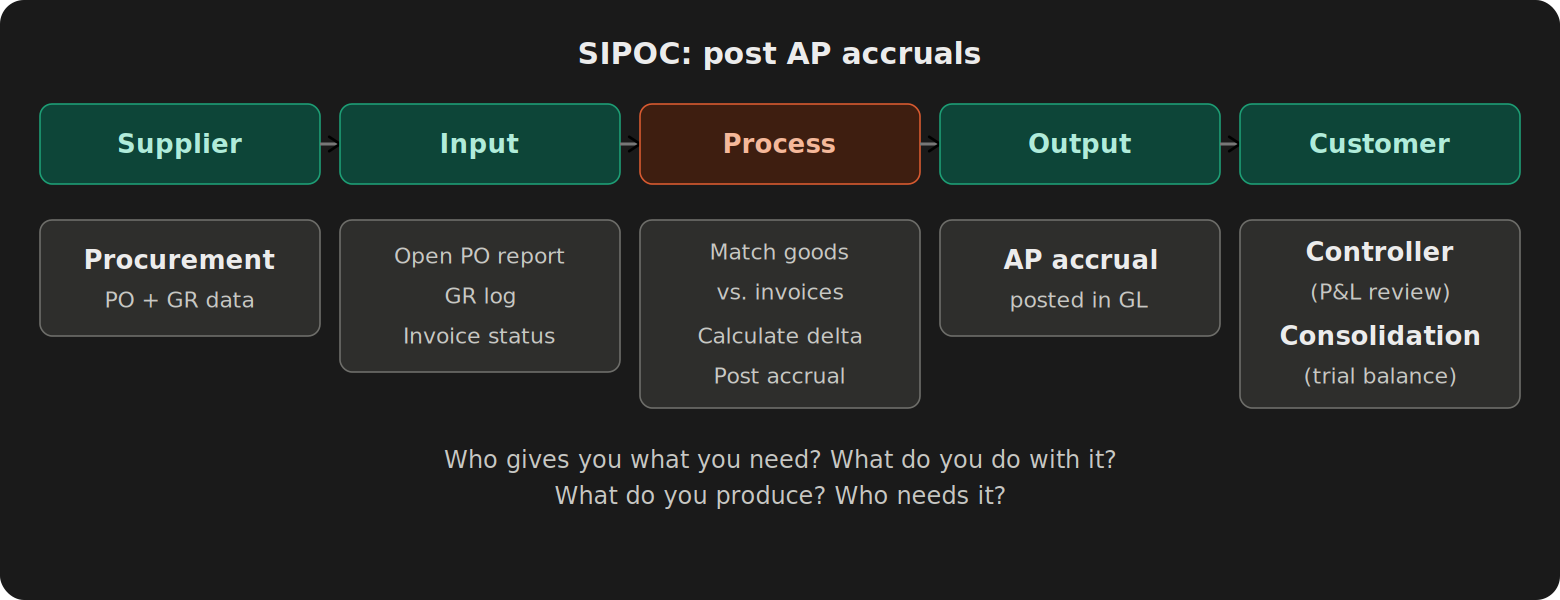
One task looks obvious when you write it out. Do it for every task in your close and the picture changes fast.
Here's a second example to show how the same framework works in a completely different part of the close.
Task: Revalue foreign currency balances.
Supplier: Treasury (provides hedge positions and forward rates), ERP system (provides open item balances by currency).
Input: Open AR/AP items in foreign currency, month-end exchange rates from the central bank or rate provider, hedge documentation.
Process: Run the revaluation program in the ERP, compare unrealized gains/losses against hedge positions, post adjusting entries, reconcile to the treasury report.
Output: Revalued balance sheet positions, unrealized FX gain/loss posted to the P&L, reconciliation to treasury.
Customer: The group controller (for consolidation and elimination of intercompany FX), external auditors (for hedge effectiveness testing).
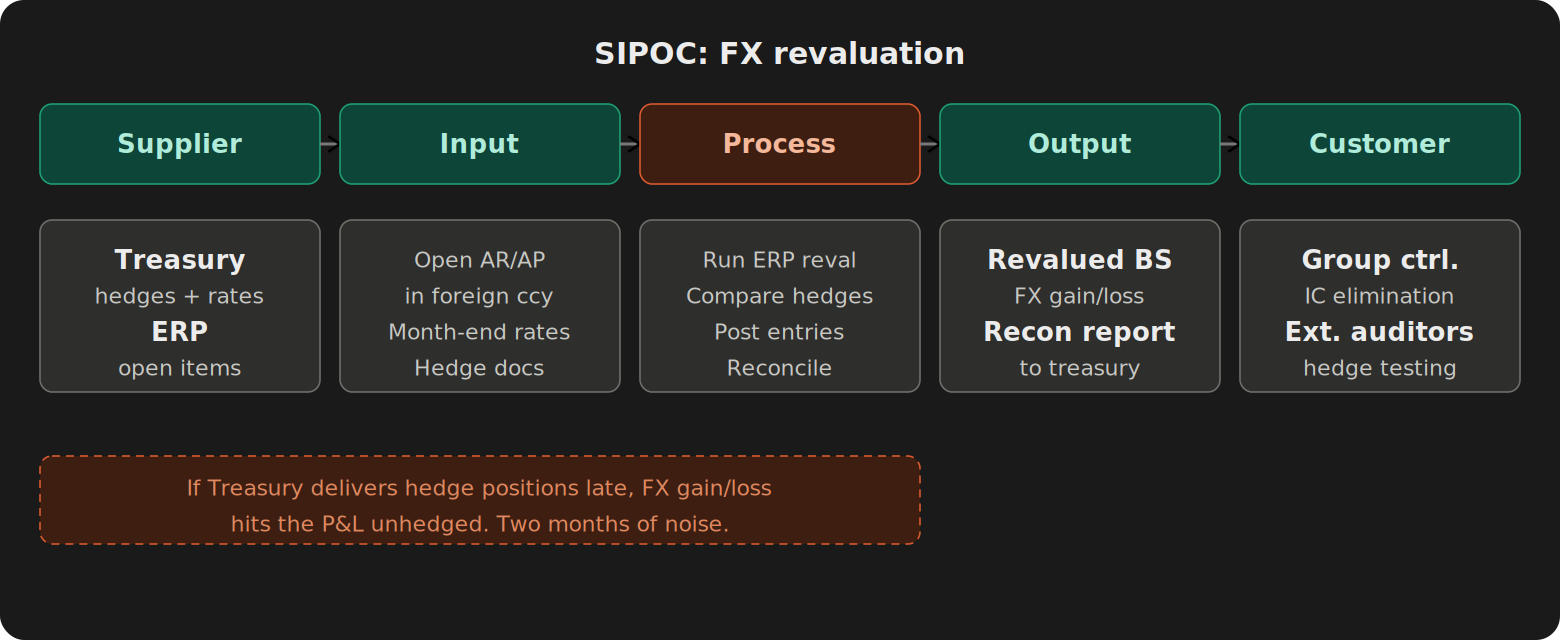
Notice how this one immediately surfaces a dependency most teams leave unspoken: if Treasury doesn't provide hedge positions before the revaluation runs, the FX gain/loss hits the P&L unhedged. That mismatch gets corrected the following month with a reversal. Two months of noise in the P&L because nobody mapped the handoff.
That's what SIPOC does. It makes the invisible visible.
What SIPOC actually reveals
I mapped a full manufacturing close this way. 127 tasks across 7 phases. Here's what came out of it.
Tasks where the supplier was unclear. Nobody officially owned the input. Data showed up late, incomplete, or in the wrong format, and everyone had been dealing with it for years. "That's how it's always been." Right. That's the problem.
Tasks where the output went to someone who didn't use it. A report reformatted every month into the controller's preferred Excel layout. Took two hours. Nobody made a decision from it. Nobody had questioned it because it was always on the checklist.
Tasks where the process itself was a workaround for something upstream that was never fixed. The real problem was three steps earlier, but nobody had traced the chain because nobody had drawn the chain.
When we presented the map, the pushback was immediate. Executive finance directors, people with the title but none of the operational depth, told us we were wasting their time. Meanwhile these same people were running quarterly workshops with no concrete output. No methodology, no process maps, no before-and-after measurements. Just meetings about meetings.
They assumed best practices lived in the biggest manufacturing sites. Wrong. Some of the best practices were in small sites where people had time to think processes through. They assumed the longest-tenured people would know best how to optimize. Also wrong. Seniority is proof you survived the corporate politics the longest, not that you have the recipe for efficiency.
Finance operational excellence is a craft. It requires the right methodology and the honesty to start with work nobody had the courage to do. Map who's doing what and how. There's no workaround.
Common mistakes when building your first SIPOC
After running this exercise across multiple sites and teams, the same mistakes keep showing up.
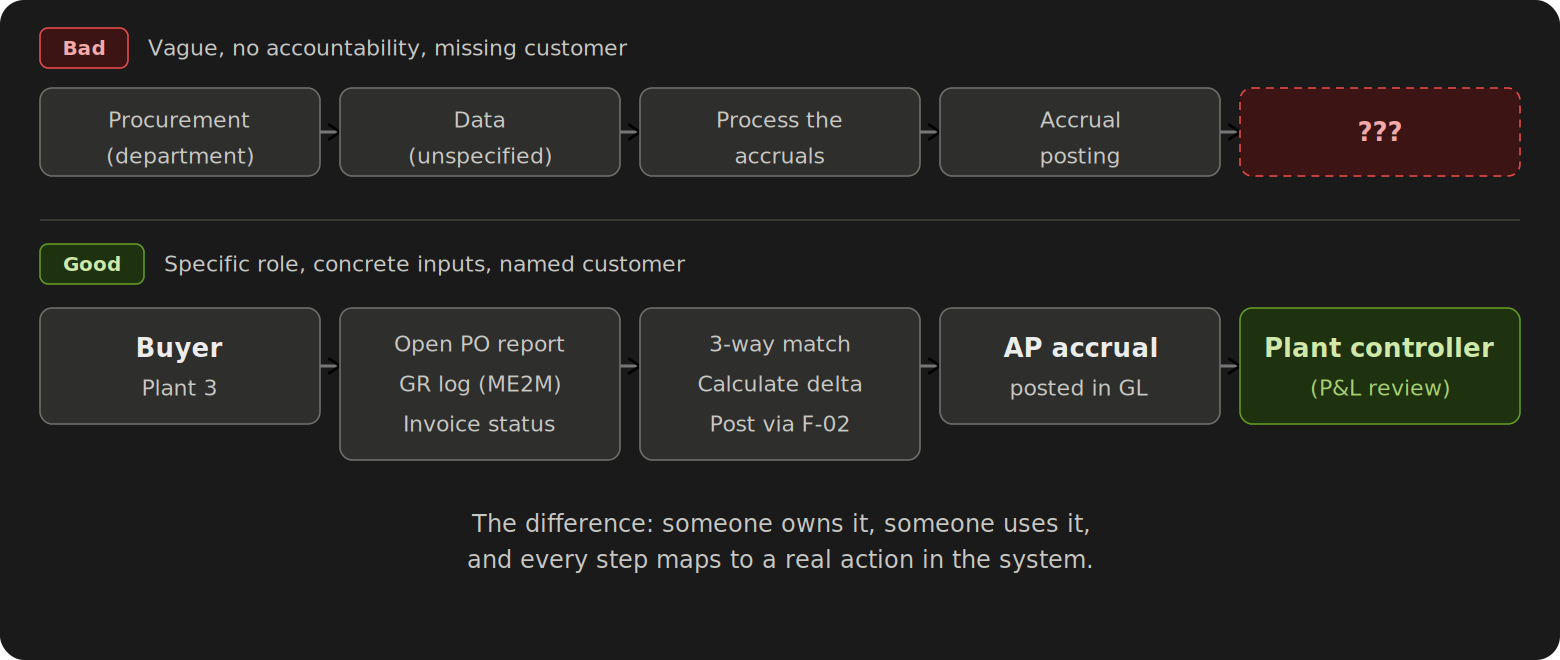
1. Writing the SIPOC from memory instead of observation. Managers describe how things should work, not how they actually work. The people who know are the ones doing the tasks. If you're not sitting with them and watching the process, you're documenting a fantasy.
2. Naming a department as the supplier instead of a person or role. "Procurement" doesn't send you anything. A specific buyer or purchasing coordinator does. When you write "Procurement," nobody feels accountable. When you write "Buyer — Plant 3," someone owns it.
3. Skipping the customer column. Teams treat SIPOC as a glorified task list: input, process, output, done. But the customer column is where the real questions surface. Who actually uses this output? Do they need it in this format? Do they need it at all? I've seen teams cut hours from their close just by answering that column honestly.
4. Mapping too high. "Close the books" is not a SIPOC-level task. "Post AP accruals" is. "Reconcile intercompany" is. If your process description spans more than two or three sentences, you're too high. Break it down until each task has one clear owner and one clear output.
5. Treating the SIPOC as a one-time exercise. The map is only useful if it's alive. Processes change. People leave. ERP configurations get updated. If you build the SIPOC and file it in SharePoint, it becomes exactly the kind of documentation that Lean Six Sigma was supposed to replace: a deliverable nobody reads.
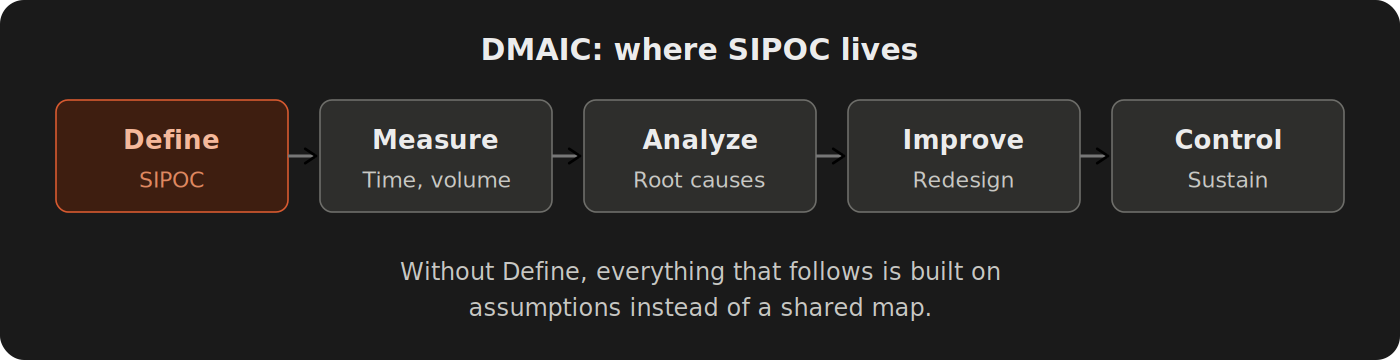
Where SIPOC sits in DMAIC
DMAIC is the structured problem-solving framework behind Lean Six Sigma: Define, Measure, Analyze, Improve, Control. Five phases.
SIPOC lives in the first one.
Without it, people in the room have different mental models of how the work flows. Nobody realizes it until the improvement stalls and someone says "wait, that's not how it actually works."
SIPOC is the agreement. Here is what we do, step by step, with names on every handoff. Once that exists, you can start measuring: where does time go? Which tasks sit on the critical path? Which handoffs fail every month? All of that depends on the map being real.
If you don't start with SIPOC, you're probably starting wrong.
Does this actually produce results?
BMO Financial Group deployed Lean Six Sigma across their operations starting in 2005 and projected annualized savings of nearly $55 million over five years on $5.3 million invested, winning two Global Six Sigma Awards in the process. One investment management firm discovered that out of 38,000 line items on their general ledger, only 500 accounted for 75% of total expenses. They found that by mapping the process, not by staring at a dashboard.
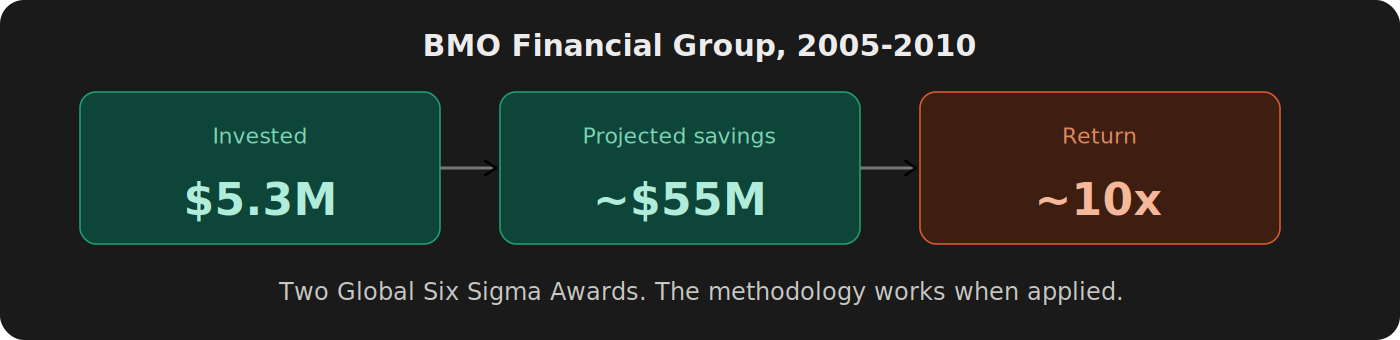
These aren't small wins. And they didn't come from buying new software or hiring consultants to tell them what they already knew. They came from people sitting down, mapping the work, and finding the waste that was hiding in plain sight.
The methodology works when applied. The problem isn't the tools. The problem is that nobody uses them.
SIPOC is step one. Here's what comes after.
Mapping the process is where it starts. But a SIPOC alone won't tell you which tasks are worth protecting, which can be streamlined, and which should be eliminated. It won't tell you which 30% of your tasks are on the critical path and which ones have slack. It won't show you that your Senior Accountant is triple-booked on Day 2 while another role sits idle on Day 4. It won't trace why the same AP accrual has been late 8 months out of 12 to a missing agreement three steps upstream.
That takes a full system. SIPOC feeds into value classification (what to protect, streamline, or eliminate). Value classification feeds into critical path analysis (which tasks control your deadline). Critical path feeds into resource scheduling (where your team is overloaded). That feeds into waste decomposition (the eight types of time loss). Then root cause analysis (why the same problems repeat). Then upstream dependency mapping (the 34% of your close that depends on people you don't control). Then a tracked improvement plan with dollar impact that turns "we should fix that" into "approved, go ahead."
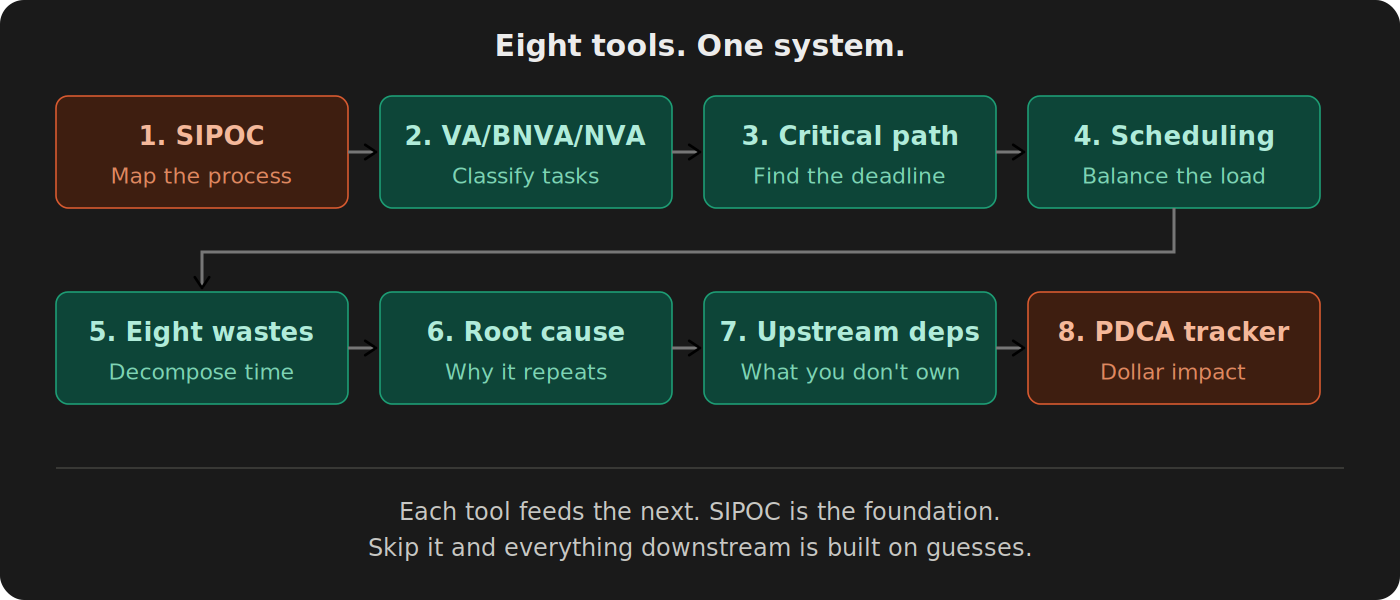
Eight Lean Six Sigma tools. One system you apply to your own close.
If you want to see how value classification works as the next step after SIPOC, read Most of Your Close Isn't Waste. It's Worse: It's Misclassified. — the second article in this series.
Try SIPOC in 30 minutes
Pick five tasks from your close. Any five. Write the SIPOC for each. One sentence per element.
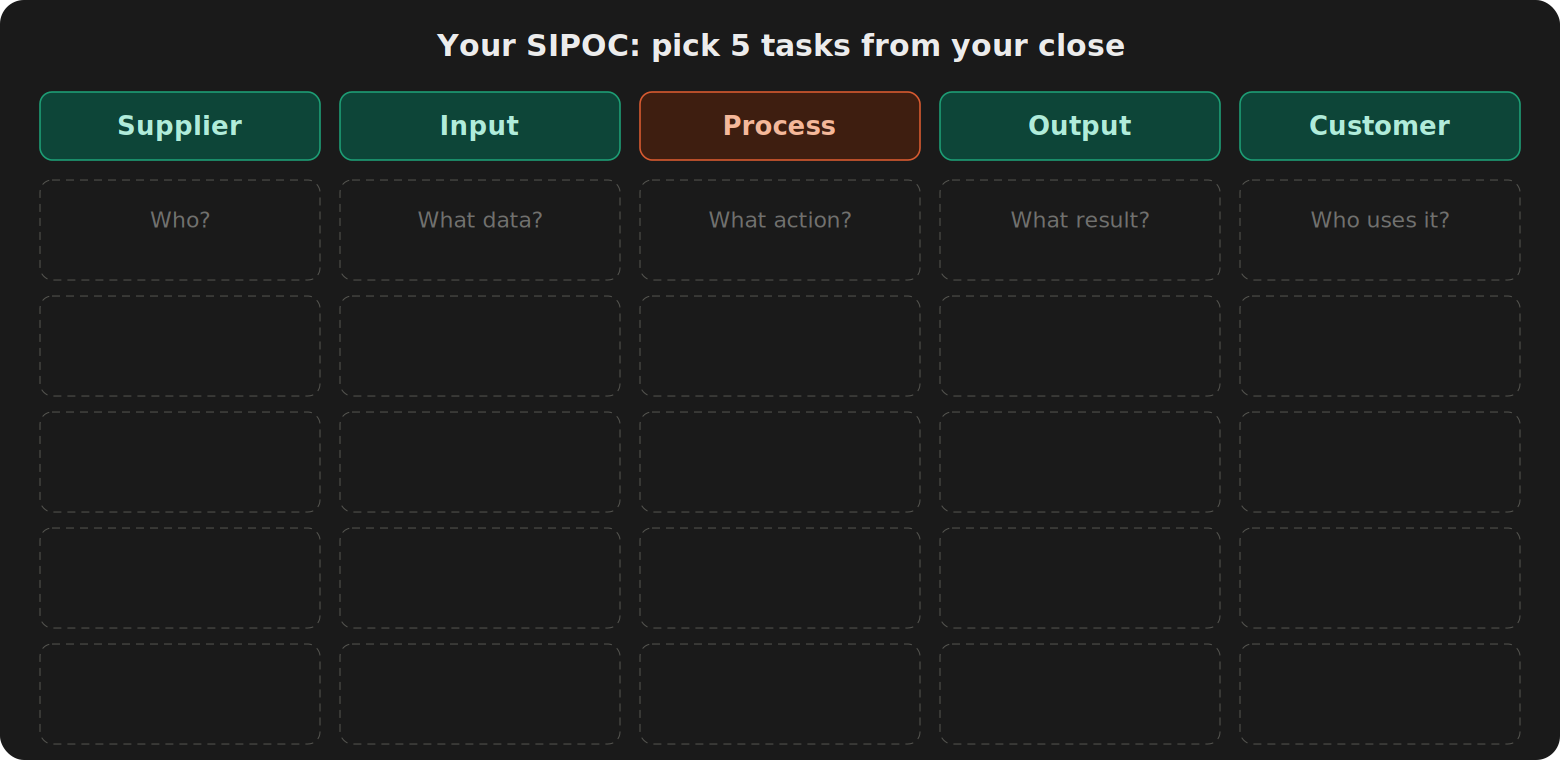
If you get stuck on one, that's the task worth talking about with your team. The one you can't describe clearly is almost always the one causing problems every month.
I built a crash course that applies all eight tools to a full 127-task month-end close. You walk out with a working Excel operating model you can use on your own close the same week. SIPOC, value classification, critical path, resource scheduling, the eight wastes, root cause analysis, upstream dependencies, and a PDCA improvement tracker with auto-calculated dollar impact.
→ Month-End Close Optimization — 10 lessons, one working system
Frequently asked questions
What does SIPOC stand for? Supplier, Input, Process, Output, Customer. Each element maps one aspect of a process step: who provides the data, what they provide, what you do with it, what you produce, and who receives it.
When should I use SIPOC vs. a full process map? SIPOC comes first. It gives you the high-level view of every task before you invest time in detailed flowcharts or swimlane diagrams. If you don't have a SIPOC, your process map is built on assumptions about how things connect.
Can SIPOC work outside of manufacturing? Yes. The examples here are from manufacturing finance, but SIPOC applies to any repeatable process with handoffs. Shared service centers, FP&A reporting cycles, treasury operations, audit prep. If there's a supplier and a customer for a task, SIPOC maps it.
How long does it take to build a full close SIPOC? For a 100+ task close, expect two to three days of focused work with the people who actually do the tasks. That includes interviews, drafting, and review. The time investment pays back within the first close cycle when you start catching handoff failures before they become fires.
Sources
APQC General Accounting Open Standards Benchmarking Survey (2017) — 2,300 organizations surveyed. Median close cycle: 6.4 calendar days. Top 25%: 4.8 days or less. Bottom 25%: 10+ days.
Ledge, "The State of Month-End Close in 2025" — 100 finance professionals surveyed. 50% take 6+ business days to close. Only 18% close in 3 days or less.
FloQast & University of Georgia, "Burnout in the Accounting Profession" (March 2022) — 204 accounting and finance professionals surveyed. 81% had at least one month where the close disrupted their personal lives.
Eagle Rock CFO, "Month-End Close Benchmarks 2026" (February 2026) — Approximately 30% of companies have a fully documented close checklist.
BMO Financial Group press release (November 19, 2007) — Projected annualized savings of nearly $55 million over five years on $5.3 million invested.
The Lab Consulting, "Lean Six Sigma Projects for Finance and Accounting Transformation" (2018) — 38,000 GL line items, 500 accounted for 75% of total expenses.
This article originally appeared in the Practical Lean Finance newsletter on LinkedIn.